The Diamond Formation:
First, there should be a bit of background towards the diamond formation, it's working, strengths, weakness and examples of great teams of past and present who've made winnings from this formation.
Formation: (ex. AC Milan 2003/2004)
 |
| AC Milan vs Inter Milan (away) 2003-04 Serie A (c) Football-lineups.com |
Strengths:
First thing noticeable about the formation is it's strength in numbers down the center of the pitch, a slight tweak of the diamond, known as the 'christmas tree', makes even more use of the dominance in central midfield by replacing one of the strikers with another central attacking midfielder, a ploy AC Milan used as well in some important matches. With four central midfielders, this formation would dominate most other popularly used formations during it's time, such as the 4-4-2 and the 3-5-2, in the center of the pitch.
The dominance in the center does not only contribute to the ascendancy in terms of possession but also contributes quite well to the teams defensive ability. AC Milan played essentially with only one pure defensive midfielder in Generro Gattuso but both he and Andrea Pirlo, who himself was not known for his defensive abilities, were assisted by the central positioning of the usually offensive but nonetheless energetic Clarence Seedorf. Mentioning Andrea Pirlo in this line-up brings up another strength of this formation, which can well be the difference between this formation making a good and great team, it's ability to suit the 'deep playmaker'.
We've seen a recent reemergence of the deep playmaker position in football. A position which was held with esteem amongst many of the best teams of the 90's such as Real Madrid with Fernando Redondo, AC Milan with Albertini and Barcelona with Pep Guardiola. With the movement towards 4-4-2 and an importance towards dominance down the wings, the role of the deep playmaker became more and more inconsequential. The recent dominance of Barcelona, and the exponential rise in stature of their own deep playmaker, Xavi, has given back life to the idea of dominating the center of the pitch, like Barcelona do so well, rather than the wings.
If you want to truly dominate the best sides in the world in the center of the pitch, you need more than just numbers. A player like Andrea Pirlo is the difference between winning and dominating the center of the pitch. The diamond formation at AC Milan was what brought the best out of the Italian, who had a failed stint at Inter Milan, playing as an attacking midfielder, before joining their inter-city rivals. It's not difficult to see why, as explain in this article, the diamond formation can be best suited for a deep playmaker. As mentioned in the article, a deep playmaker's primary role is pass the ball with accuracy while also being helpful defensively. A problem with deep playmakers can sometimes be their lack of pure defensive ability, case in point being Xabi Alonso and Bastian Schweinsteiger, both of whom need the help of the more defensively able Sami Khedira to play at their best. With the diamond formation, Pirlo received not one but two helping hands, the pure destroyer Genarro Gattuso and the energetic Clarence Seedorf, both of whom helped out defensively and enabled Pirlo to concentrate on finding spaces so that when he received the ball, he could be able to distribute it forward with perfection and also took a bit of opposition midfield pressure off him while in possession.
Weaknesses:
There is a certain reason why the diamond formation has gradually gone out of style in recent years. Much of it has to do with the popularization of the 4-2-3-1, a formation which not only helps in adding numbers to the center of the pitch but also, crucially, provides the team with a source of width in the form of two wingers. That, in essence, is the main weakness of the diamond formation, the lack of attacking and defensive support wide of the pitch.
A clear example of this has come in two big games, AC Milan vs Tottenham Hotspur in the 2010-11 Champions League and Italy vs Germany in the 2012 European Championships. AC Milan played their usual diamond formation while Tottenham played 4-2-3-1 with Aaron Lennon as their right winger. Aaron Lennon was a constant menace throughout and ultimately broke forward and created the winner for Spurs. In the second match between Italy and Germany, the young Germans, who'd been the most impressive team of the tournament with their vibrant mixture of attacking football through the wings and dominance in the center of the pitch, considerably changed their tactical outlook in order to combat Italy's diamond formation. Joachim Low brought on Toni Kroos (something I suggested in this article) for Thomas Muller and moved Ozil to the right wing (something I didn't suggest). That ultimately made Germany lose their attacking width as Ozil was playing more centrally (and deeper), in order to reduce the numerical advantage Italy would have in that area, rather than as a winger.
Italy quickly grabbed a 2-0 lead by half time and looked very comfortable against the tweeked German side. Low responded by bringing on Marco Reus for Lukas Podolski and shifted Ozil to the left wing while Reus moved to the right. Reus would ultimately get plenty of possession in the wide right area and cause enough trouble to Prandelli in the first 10 minutes of the second half that Prandelli took off his most impressive player of the night, Antonio Cassano, and brought on Diamanti who was shifted to the left forward position as Prandelli went to a 4-3-3 in order to curb with Reus' threat. Germany's initial threat fizzled out and they weren't able to comeback.
Characteristics of the diamond formation (ex. Italy Euro 2012):
 |
| Italy average position vs Germany Euro 2012 (c) whoscored.com |
1) Italy had the third highest percentage of play in the middle of the park (behind Ireland and Spain) with 33% of their possession in that area.
2) Italy averaged the tied third lowest crosses per game (17 at 3% of their passes per game) while only completing 4 crosses against Germany in the semi final.
3) Ignazio Abate, Italy's right wingback, averaged the highest crosses attempted per game for Italy with 4.
Manchester United and the diamond formation:
Observations:
Till now, the diamond formation as been used in three matches, two of which were in the UEFA Champions League while the other was against Newcastle at St.James Park. Let's have a look at some observations that can be taken from these matches:
Kagawa's position vs Newcastle and Braga:
It's important to focus Kagawa's role in this formation since his arrival and unignorable ability has pushed Sir Alex to find alternative's to his planned 4-3-3 formation in order to fit him, and Wayne Rooney and Robin Van Persie.
 |
| Left: Kagawa vs Newcastle (A), Right: Ambrosini vs Atalanta (H) (c) Squawka.com |
 |
| Marchisio vs England (c) uefa.com |
First thing which is noticeable about Kagawa's position is that is not really that of a central midfielder but rather closer to a right winger. A comparison can be made with AC Milan's Ambrosini who played a similar position, right side of the diamond, in AC Milan's 0-1 loss to Atalanta earlier this season. Another comparison can be seen Claudio Marchisio vs Germany in the Euro 2012 semi final. Both Italian players seem to have more central play than Kagawa and less possession in the right wing position. This is counter productive to the purpose of the diamond formation, which is to allow Kagawa to play where he prefers to, centrally and just behind the main striker, a position that Wayne Rooney was occupying.
While Kagawa was playing at the right side of the diamond vs Newcastle, against Braga in the Champions league he was deployed on the left side, with Cleverley moving to the right side, and the change in his positioning was immediate.
 |
| Left: Average position vs Newcastle, Right: Average position vs Braga |
Robin Van Persie, Wayne Rooney and United's crosses:
Playing the diamond formation, United have improved their crosses per game ratio by reducing it to 3.4% (22 per game from a season average of 28 per game at 4.6%)* by playing the diamond formation, the worrying aspect is where the crosses are coming from. While it has been stated earlier in this article that the crosses from a diamond formation usually come from the wing backs, as was seen with Italy in the 2012 Euro's, the leading crosses for Manchester United in this formation over the three matches were Robin Van Persie (18*) and Wayne Rooney (19*) while the full backs combined to attempt only 14* crosses over the same three matches. Robin Van Persie's tendency to cross is more worrying than that of Wayne Rooney since you would expect Van Persie to be the striker finishing those chances rather than being the one creating them.
 |
| Left: Van Persie v Arsenal (H), Right: Van Persie v Newcastle (A) (c) Squawka.com |
It's clear to see Van Persie's greater tendency to move out wide when playing the diamond formation (the Newcastle heat map has been taken till the Kagawa substitution) rather than the 4-4-2 United played against Arsenal. In that match, Van Persie only attempted three crosses (Manchester United though attempted a ratio of 5%* of passes as crosses), which does suggest that Van Persie was resisting a move to the wings since United already had plenty of width provided by Antonio Valencia down the right and Ashley Young down the left, which is not the case when the diamond formation is played.
Struggling with lack of width:
As already mentioned, Shinji Kagawa was substituted early in the second half in the matches against Newcastle and Braga. While United were still in a comfortable situation at St James Park the run of play did not suggest that and at Braga United entered the second half down two goals to one. Therefore, in both cases, United were struggling to implement their narrow diamond formation in the match and Sir Alex had to switch to the wider 4-4-2 or 4-2-3-1 formation, which the United players seemed much more comfortable with. While United's performance at St James Park wasn't a marked improvement from the first half, they did managed to come back from the 2-1 deficit against Braga and win 3-2 with winner coming from a deep cross by Tom Cleverley.
Looking ahead:
Winners and Losers of the formation:
Many will think that the switch to the diamond formation was made to suit the needs of Rooney-Van Persie and Kagawa but there are still some other players who will benefit from the use of this formation. Tom Cleverley looks like one who will definitely develop from the use of this formation. While Cleverley's place in the starting line-up is not in doubt anymore, given his qualities on the ball and his offensive off-the-ball movement, what he does lack is a defensive ability. When the youngster made his first steps into the first team at the start of the 2011-12 season, those steps seemed more like dashes as he and Anderson dazzled the Old Trafford crowd with their scintillating displays of attacking football against the likes of Spurs and Arsenal. But while United managed to score 13 goals in those three matches, they also conceded three goals but more importantly 57*** total shots, the most of any team at that stage. The lack of defensive ability from either Cleverley or Anderson meant that United were culpable to attacks down the center of the pitch.
Cleverley's strength's clearly lie in his offense rather than defense, the same case being with Anderson and therefore playing the diamond formation could help give Cleverley a bit more freedom to express his creativity while not sacrificing a lot on the defensive side, which is not the case when United play with only two central midfielders, as is the case in 4-4-2. An interesting stat illustrates just how weak United's midfielders are at defending with United having conceded a massive 75% of their goals to opposition midfielders, comparable statistics with Chelsea (22%), Manchester City (11%) and Arsenal (18%) shows the vast difference in the ability of those teams and United to defend against midfielders***. The way the diamond formation can help Cleverley and Manchester United defend against midfielders is by of course adding numbers to that area of the field in order to help marking runners. If Cleverley has the support of players such as Fletcher and Carrick behind him and with the tracking back of Rooney/Kagawa, he can concentrate more on his forward passing game, which can definitely benefit Manchester United. The combined defensive effort of all four central midfielders will bring greatly benefit United's defence overall.
The same logic can be used on my next set of players, Michael Carrick and Paul Scholes. When talking about AC Milan's Champions League winning diamond formation, it was said about how the diamond formation brought the best out of their deep playmaker, Andrea Pirlo. It is not difficult to see that the same arguments made then can be applied to Carrick and Scholes, both of whom now play a ditto role to that of Pirlo. Carrick has shown weakness in some areas of his game such as his strength when under pressure but one area that has never been criticized is his passing. In that sense, Carrick is perfect for the role of deep playmaker in the diamond formation, one which can allow him to find space to pass with more freedom. It has been mentioned in this article how the presence of more Italian central midfielders allowed Pirlo more space to orchestrate Italy's attack since their presence was an issue for the outnumbered English central midfielders; there would always have to be one open midfielder. Just as Michael Carrick could benefit, so can Paul Scholes, who at the age of 38 can still pull off superb performances at the center of the pitch with his passing but whose lack of physicality has been an issue for United lately.
Now moving towards the losers, the most obvious ones first off would be the wingers, Antonio Valencia who would be the most disappointed. The current holder of the Manchester United Players Player of the Year, the Ecuadorian is one of the last true high quality wingers left in the game and has been a vital player in United's attack since his arrival in 2009. Such was his quality that United clearly preferred to play down their right side, averaging 39% of their possession down the right (third highest in the league) last season compared to 30% central and 31% left*. While Valencia has a history of playing as a central midfielder for his national team, the role in that side would be much different of what will be required at United. Ofcouse, alongside Valencia, Nani and Ashley Young would also lose out though their lose might not be as great given their inconsistent performances of the past year.
Width has always been an important part of Manchester United's attacking philosophy, as stated by Sir Alex on many occasions. Manchester United ranked as the highest crossers of the ball (29 per game)** last season but, overall, the strength of United over other teams with regards to their wing play is clear. While they crossed the ball the most times per game last season, Manchester United also scored the most headed goals (24)** while their percentage of goals scored from headers was the third highest (28%)**; behind not surprisingly Stoke City and Blackburn Rovers. Therefore, with so much emphasis, and success, from wide play last season, it can be said width as a whole will be the biggest loss for Manchester United with the implementation of the diamond.
Formation and Final Thoughts:
The most important aspect of the diamond formation would be for both tips to work (i.e Kagawa and Scholes/Carrick). Kaka and Pirlo spearheaded those areas for AC Milan and their impact on matches was clear to see, it is paramount that Manchester United look to gather the same level of performances from Kagawa and Scholes/Carrick. It does seem quite simple as to how to blend the deep playmaker into the formation but the difficulty would be on how to make Kagawa and Rooney work together given how similar both players are. Both like to play the role behind the main striker, who will be Robin Van Persie:
The side by side heat maps show the similarity in the roles of both players. Though Rooney is always marked as a striker, Sir Alex has clearly given him in a free role in the team to move and conduct play however he wants and this is where the manager is going to have considerable difficulty since Kagawa likes to play that similar role as well. The only one possibility would be to ask Kagawa to work around the play of Rooney and make runs off the ball into space. At Dortmund, Kagawa's running off the ball was considered to be a major feature of his arsenal and his goalscoring record (21 goals in 49 matches) shows that he has the ability to pick the back of the net. A possible issue for Manchester United could arise with Rooney's lack of true playmaking ability. Though Rooney does possess a wide range of passes, it is, and has been, said that Rooney lacks the ability to play 'killer' through balls which create chances. The statistics show this , Rooney's percentage of passes as key (2.66) (excluding set pieces) is much lower than players such as Juan Mata (3.66), David Silva (3.58) and Nasri (3.10)**. Rooney's statistics in that regard might be low but then again those of Antonio Valencia (3.47) and Nani (3.16) are much better with both coming in the top 20 (Rooney is 32)**. This once again begs the question just as to why Sir Alex is thinking of playing the diamond formation.
This article isn't completely about bashing the idea of Manchester United playing with a diamond formation, the reasons for playing this can clearly be seen as Manchester United have struggled for much of the last two seasons to dominate, and defend the, central midfield against the biggest teams in England and Europe and therefore trying to fortify that area of the field, one which has become the most important in football today, can be considered vital. Giving support to limited players such as Cleverley, Carrick and Scholes (now limited, it should be said) in order to let them play to their strengths could be the key to getting the best out of their potential and Sir Alex sees that as more promising than continuing his tradition of focusing on wide formations and world class wingers.
* Stats from www.whoscored.com
** Stats from MCFC Analytics Worksheet.
*** Stats from www.football-line-ups.com
As already mentioned, Shinji Kagawa was substituted early in the second half in the matches against Newcastle and Braga. While United were still in a comfortable situation at St James Park the run of play did not suggest that and at Braga United entered the second half down two goals to one. Therefore, in both cases, United were struggling to implement their narrow diamond formation in the match and Sir Alex had to switch to the wider 4-4-2 or 4-2-3-1 formation, which the United players seemed much more comfortable with. While United's performance at St James Park wasn't a marked improvement from the first half, they did managed to come back from the 2-1 deficit against Braga and win 3-2 with winner coming from a deep cross by Tom Cleverley.
Looking ahead:
Winners and Losers of the formation:
Many will think that the switch to the diamond formation was made to suit the needs of Rooney-Van Persie and Kagawa but there are still some other players who will benefit from the use of this formation. Tom Cleverley looks like one who will definitely develop from the use of this formation. While Cleverley's place in the starting line-up is not in doubt anymore, given his qualities on the ball and his offensive off-the-ball movement, what he does lack is a defensive ability. When the youngster made his first steps into the first team at the start of the 2011-12 season, those steps seemed more like dashes as he and Anderson dazzled the Old Trafford crowd with their scintillating displays of attacking football against the likes of Spurs and Arsenal. But while United managed to score 13 goals in those three matches, they also conceded three goals but more importantly 57*** total shots, the most of any team at that stage. The lack of defensive ability from either Cleverley or Anderson meant that United were culpable to attacks down the center of the pitch.
Cleverley's strength's clearly lie in his offense rather than defense, the same case being with Anderson and therefore playing the diamond formation could help give Cleverley a bit more freedom to express his creativity while not sacrificing a lot on the defensive side, which is not the case when United play with only two central midfielders, as is the case in 4-4-2. An interesting stat illustrates just how weak United's midfielders are at defending with United having conceded a massive 75% of their goals to opposition midfielders, comparable statistics with Chelsea (22%), Manchester City (11%) and Arsenal (18%) shows the vast difference in the ability of those teams and United to defend against midfielders***. The way the diamond formation can help Cleverley and Manchester United defend against midfielders is by of course adding numbers to that area of the field in order to help marking runners. If Cleverley has the support of players such as Fletcher and Carrick behind him and with the tracking back of Rooney/Kagawa, he can concentrate more on his forward passing game, which can definitely benefit Manchester United. The combined defensive effort of all four central midfielders will bring greatly benefit United's defence overall.
The same logic can be used on my next set of players, Michael Carrick and Paul Scholes. When talking about AC Milan's Champions League winning diamond formation, it was said about how the diamond formation brought the best out of their deep playmaker, Andrea Pirlo. It is not difficult to see that the same arguments made then can be applied to Carrick and Scholes, both of whom now play a ditto role to that of Pirlo. Carrick has shown weakness in some areas of his game such as his strength when under pressure but one area that has never been criticized is his passing. In that sense, Carrick is perfect for the role of deep playmaker in the diamond formation, one which can allow him to find space to pass with more freedom. It has been mentioned in this article how the presence of more Italian central midfielders allowed Pirlo more space to orchestrate Italy's attack since their presence was an issue for the outnumbered English central midfielders; there would always have to be one open midfielder. Just as Michael Carrick could benefit, so can Paul Scholes, who at the age of 38 can still pull off superb performances at the center of the pitch with his passing but whose lack of physicality has been an issue for United lately.
Now moving towards the losers, the most obvious ones first off would be the wingers, Antonio Valencia who would be the most disappointed. The current holder of the Manchester United Players Player of the Year, the Ecuadorian is one of the last true high quality wingers left in the game and has been a vital player in United's attack since his arrival in 2009. Such was his quality that United clearly preferred to play down their right side, averaging 39% of their possession down the right (third highest in the league) last season compared to 30% central and 31% left*. While Valencia has a history of playing as a central midfielder for his national team, the role in that side would be much different of what will be required at United. Ofcouse, alongside Valencia, Nani and Ashley Young would also lose out though their lose might not be as great given their inconsistent performances of the past year.
Width has always been an important part of Manchester United's attacking philosophy, as stated by Sir Alex on many occasions. Manchester United ranked as the highest crossers of the ball (29 per game)** last season but, overall, the strength of United over other teams with regards to their wing play is clear. While they crossed the ball the most times per game last season, Manchester United also scored the most headed goals (24)** while their percentage of goals scored from headers was the third highest (28%)**; behind not surprisingly Stoke City and Blackburn Rovers. Therefore, with so much emphasis, and success, from wide play last season, it can be said width as a whole will be the biggest loss for Manchester United with the implementation of the diamond.
Formation and Final Thoughts:
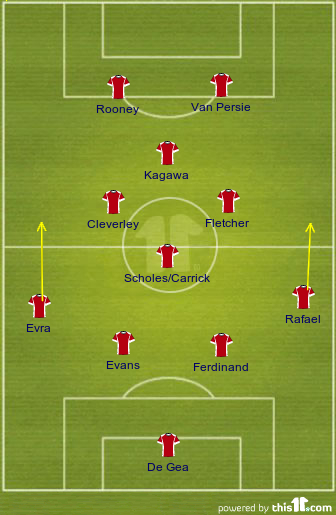 |
| My preferred diamond line-up. |
 |
| Left: Kagawa vs Fulham (H), Right: Rooney vs Stoke (H) (c) Squawka.com |
This article isn't completely about bashing the idea of Manchester United playing with a diamond formation, the reasons for playing this can clearly be seen as Manchester United have struggled for much of the last two seasons to dominate, and defend the, central midfield against the biggest teams in England and Europe and therefore trying to fortify that area of the field, one which has become the most important in football today, can be considered vital. Giving support to limited players such as Cleverley, Carrick and Scholes (now limited, it should be said) in order to let them play to their strengths could be the key to getting the best out of their potential and Sir Alex sees that as more promising than continuing his tradition of focusing on wide formations and world class wingers.
* Stats from www.whoscored.com
** Stats from MCFC Analytics Worksheet.
*** Stats from www.football-line-ups.com

No comments:
Post a Comment