
Three matches, one draw, one loss and one very embarrassing loss. After a promising pre-season, including a win against Real Madrid, everything seemed bright and rosy for the competitive start to Louis Van Gaal's era at Manchester United. There was already much optimism from United fans regarding Van Gaal's appointment even before pre-season, down much to the reputation of the Dutchman throughout Europe and Holland's unexpectedly great run in the World Cup.
A few injuries to key players, Luke Shaw and Ander Herrera, on the start of the season though have seen United go off to a worse start than under David Moyes and caused some fans to worry about the state of their squad, even after spending over 80 million pounds in the summer. That seemed to renew United's interest in Di Maria, which persisted in the press for much of the summer. In the end, United signed the Real Madrid start for a whopping 64 million pounds, smashing the British transfer record.
While Di Maria does certainly bring on a touch of class and quality, a question that lingered in the minds of many who follow United that just how, with players like Wayne Rooney, Falcao, Robin Van Persie and Juan Mata in the team that seemed set to play 3-5-2, Di Maria fit in the team:
Van Gaal's 3-5-2:
Van Gaal asserted very early into pre-season that 3-5-2 will be the formation he will be planning to play with United and thus far he, regardless of the players he has had available, has stuck to that, therefore we can assume that we will continue with it even after the signing of Di Maria. First an overview of how Van Gaal's system has played in the first three matches.

3 center backs, followed by 3 central midfielders who are flanked by 2 wing backs and fronted with 2 strikers. The formation is one which was used throughout the 90's but slowly lost significance as teams started to use the 4-2-3-1, one which renders 3 center backs redundant and leaves the 3-5-2 with not enough defensive support down the wings. The formation though has slowly crept back into the European game with many Italian teams once again adopting the formation, though their success on the continental stage is still being debated. It's a formation which requires most importantly high energy wing backs, on both flanks to not only come back and support the defense when without the ball but also provide width in attack. The central midfielders basically operate as under other common 3 man formations like the 4-3-3 and 4-2-3-1, though the most defensive midfielder sometimes drops more regularly between the center backs.
Di Maria as a LWB:
Di Maria started his European career out at Benfica and played majority of his time there as a left winger, he continued to play in that position for Argentina during the same time, including in the 2010 World Cup. Though he moved to a right winger position after signing for Real Madrid, the immense work rate and tenacity he has shown throughout his team at Real Madrid, especially during his later years, has thrown into thought the idea of him being adopted as Van Gaal's LWB in the 3-5-2. This though is a very rare possibility as United have already spend 35 million pounds on Luke Shaw, a promising 19 year old LB, who will be expected to fill the role for a long time to come.
Di Maria as a CM:
While Di Maria played his first three seasons at Real Madrid as a RW and occasionally as a LW, it was late last season that saw him moved as a part of Anchelloti's 3 man central midfield. A move that surprised many as, while Di Maria had taken up the CAM role sometimes in previous seasons, it was not seen as a position natural to Di Maria nor natural to his strengths, which were pace, dribbling and a fearsome shot along with his weakness of attempting too many irresponsible passes and wasting possession too often. All those strengths though formed into Di Maria playing out his best period for the club and one which propelled him into a player frustrating his fans into one they will adore forever for his heroics in the match that brought Real Madrid their La Decima.
1. Di Maria's Role At Madrid as a CM:
As mentioned above, the role of the 3 central midfielders in the 3-5-2 is quite similar to those deployed in the 4-3-3; therefore we can expect Di Maria to directly translate his role as a CM in Anchelloti's 4-3-3 to Van Gaal's 3-5-2. We'l look at how Di Maria played for Madrid in that position.
.png) |
| Di Maria vs A.Madrid UCL 2013-14 (c) whoscored.com |
 |
| Ronaldo vs A.Madrid UCL 2013-14 (c) whoscored.com |
.png) |
| Di Maria attempted dribbles vs A.Madrid, UCL 2013-14 (c) Squawka.com |
 |
| Ozil chance created pitch map 2013-14 (c) Squawka |
 |
| Di Maria chances created pitch map 2013-14 (c) Squawka |
United's 3-5-2 relies mostly upon the LWB, uptil now Ashley Young, to provide the width down the left flank. Besides the presence of Young, there isn't a player to occupy that flank regularly. Therefore Di Maria can exactly translate his role from Madrid as a CM to United's 3-5-2. This would provide United with a more dangerous presence down the left wing, something which they have not shown at all in the opening matches.
Di Maria did occupy the CM position in his debut match against Burnley but did not show the same aggressiveness in getting down the flank to support the left wing back as he had last season. That once again caused problems for United as their attack was impotent once again. There was some sign of hope though as Di Maria showed moments of immense quality in the few times he did decide to attack and run at defenders, infact Di Maria attempted 8 dribbles vs Burnley, compared to 0 by Cleverley in the previous match vs Sunderland. It is that attacking aggressiveness that can change United's fortunes in attack.
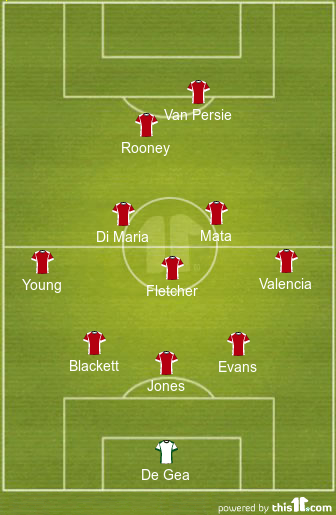 |
| United vs Burnley (A), 2014-15 (c) this11.com |
While in previous matches the midfield three usually comprised of Fletcher-Cleverley-Mata, that day Di Maria was played in place of Cleverley. The difference in positions taken up by Cleverley and Di Maria can be clear to see, and with those differences we can see the reason for the greater long balls attempted by United from the back:
 |
| Di Maria vs Burnley (A), 2014-15 (c) Squawka |
 |
| Cleverley vs Sunderland (A) 2014-15 (c) Squawka |
It's clear to see Cleverley being more involved in the buildup of attacks from the back while Di Maria, like he was with Madrid, is more involved in the attacking half down the left-center. This will be an issue for United as they will be left with no one in midfield who can start attacks (as Mata himself usually occupies forward positions rather than coming back). Therefore, with little passing options in front of them, the center backs will be forced to launch the ball forward in order to start attacks. One would ask why this wasn't an issue for Madrid when Di Maria was played there. Another might answer that the presence of Modric, while United have a more attacking player, Mata but the greater issue lies in Xabi Alonso. The positions Modric took during the previous season are quite similar to those being taken up by Mata so it's difficult to argue that Mata is not as involved in initiating the attacks as the Croatian but when we look at heat maps and passing maps of Fletcher vs Alonso, we can see the difference:
 |
| Alonso vs Getafe (A), 2014-15 Squawka |
 |
| Fletcher vs Burnley (A), 2014-15 (c) Squawka |
Once again, we can see not only Alonso being more involved in the buildup of play around the pitch but also, more crucially, we can see a lot more of his passes going forward rather than sideways or backwards, as is the very clearly the case for Fletcher vs Burnley (in fact, Fletcher currently plays 62% of his passes forward compared to Alonso's figure of 72% last season**). One should not particularly blame Fletcher for this as his primary role has always been as a defensive midfielder first while Alonso has been one of the best deep playmakers during his playing era.
These two points therefore highlight one major flaw in United's 3-5-2 with Di Maria-Mata-Fletcher in midfield. In Van Gaal's defence, he has looked to counter this deficiency by signing Ajax's Daley Blind who though playing LWB for Van Gaal during the World Cup played much of last season as a DM and, according to his agent, that is the position he has been promised to play in. His long passing abilities were on show during the World Cup, so we might expect better build up play down to his passing range.
Di Maria as a RW:
Di Maria's travels as a right winger are well known so playing him in that position would not see any negatives on his side, the only issue though would be who to occupy the left flank if United opt for a formation with wingers. Ashley Young is the only pure LW United have while Juan Mata, while initially playing as a LW with Valencia, struggled while playing as a LW last season and it is clear that his favourite position is as a CAM. Wayne Rooney could be seen as another option but again it's a case of playing a player out of his favourite position. Therefore, while Di Maria can fill the RW spot easily (as can Januazj), the problem would be filling the left winger slot.
Formations going forward:
1. 3-5-2
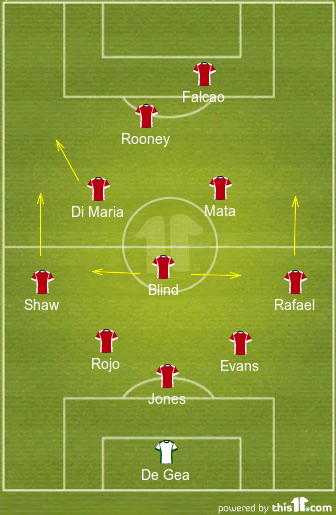
Mostly the same as what was played at Burnley except for the inclusions of new signings Falcao and Daley Blind. While Falcao will provide more aerially than Van Persie, while also offering less in terms of build up play than the Dutchman, the biggest change on the pitch will come from Blind instead of Fletcher. As mentioned above, the Dutchman showed a good range of passing during the World Cup and therefore might be able to solve the problem of building from the back that United faced against Burnley. Two noticeable absences from the line-up are Van Persie and Herrera.
2. 3-5-2 (2)
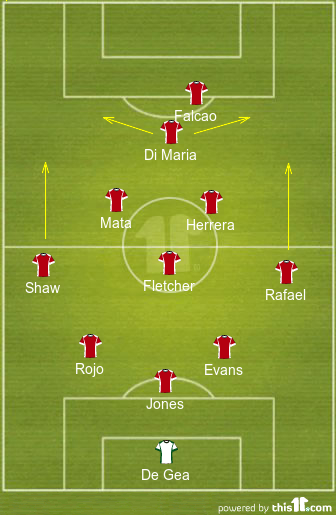
This formation is taken in inspiration of one player, Arjen Robben. There is no question who the best Dutch player was at the World Cup, and according to many the best overall player as well. Robben was at times the sole inspiration for the Dutch team when they struggled to get past the opponent's defence. It was his pure dribbling ability and ability to play a pull a rabbit out of the hat with an outstanding pass through the opposition or a shot from outside the box which made him one of the standouts of the tournament. Di Maria is a player who can provide exactly the same.
 |
| Robben vs Spain (N), World Cup 2014 (c) Squawka |
He is the player in the squad most likely to do something magical when on the ball and so, like Robben, not only for Holland but Bayern as well, should be given a free role to move across the pitch in the final third, unlike restricted to the left midfield role like in the previous formation. United have never been an offensively great team since the departure of Ronaldo and usually have relied on one person to push through a goal for them, two seasons ago Robin Van Persie did that but now with age and injuries catching up to him, it'l be difficult to see him provide something similar. Di Maria is the player who can bring back that spark that can win matches individually.
 |
| Di Maria vs Mata vs Januzaj vs Rooney vs Robben, 2013-14 league stats, (c) Squawka |
As the statistics above indicate, Di Maria provides a perfect blend not only of dribbling ability but also key passes, chance creation and assists. Robben not only matches those statistics but also beats them in some instances, which shows why he is so revered as one of the best players in the world. These statistics though show that Di Maria is the closest thing United have to Robben and therefore it might benefit them to use him in a way that Robben's coaches have.
Another positive for this formation is the strength in central midfield with Mata-Herrera-Fletcher. The combination of Herrera and Fletcher is especially important as it provides for not only better playmaking from the back than the previous formations but also more defensive strength with Fletcher's pure defensive midfield abilities and Herrera's experiences as a box to box player at his previous club.
If there is one issue with this formation though, it is the absence of pure goalscorers besides Falcao (or any other amongst Rooney and Van Persie). For all the praise Di Maria received last season, he only scored 4 La Liga goals and 11 over all though Mata has chipped in with goals at a decent strike rate since his arrival.
3. 4-4-2 Diamond
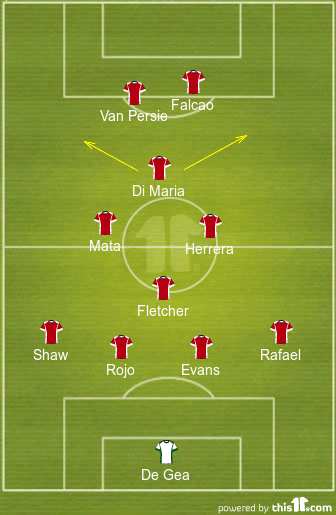
This formation patches up the one weakness of the previous formation by bringing in the extra striker for a defender. Robin Van Persie is chosen above Rooney because of Rooney's tendencies to come deep and try to influence play, which given the presence of Di Maria and Mata, he should not. Van Persie and Falcao can play the pure strikers role and pay attention to scoring off the chances the likes of Di Maria and Mata will surely provide.
The one weakness, as with all diamond formations, is that there is no cover on the wings and in a day and age where most teams have wingers in a 4-2-3-1, having no defensive support for the wing backs can make this team suffer. This formation, as used by Liverpool, can be useful for the bigger games in Europe and the Premier League where United can look to sit deep and central and then break quickly on the counter with Di Maria leading the charge. I've mentioned in more detail here the strengths and weakness of a diamond formation.
Conclusion:
It's fair to say that Di Maria is a versatile player. From starting down the left to going to the right and now seemingly settled in a central position, he has experience and has shown ability to play across the pitch. With this in mind, and appreciation of his immense abilities, it would be wrong to make him settle into playing one position, especially when he's playing in a team where he is being viewed as the best source of inspiration and creativity in attack. It is paramount that players of his calibre and allround ability, when not playing alongside Ronaldo and Messi, be given a free role above others to best demonstrate their ability.
The best part of having someone like Di Maria, apart from his obvious quality, is that he can make up switch formation without missing out on his quality and LvG should look to that to build formations according to the situation.
*Statistics provided by whoscored.com
** Statistics provided by squawka.com

No comments:
Post a Comment