 |
| Pirlo's supreme confidence and form emphasized by this superb 'paneka' penalty |
It has been an amazing last twelve months for one of the purest deep lying playmakers in the history of the game. After being cast aside by the club he served for over 10 years, AC Milan, he joined title rivals Juventus eager to still prove that he had the quality that once helped Milan win two UEFA Champions League's under his service. With a new start, and hard working players in Arturo Vidal and Claudio Marchisio around him, Pirlo certainly proved his class as he played the biggest part in Juventus' 'invincible' win of the Seria A, creating a plethora of statistical behemoths. Heading into the 2012 European Championships, everyone knew that if Italy were to have any chance of winning the trophy, Pirlo would have to carry his club form into the tournament and the Italian has done well and truly that with a string of superb performances, his best yet coming in the latest victory against England. Now its time for the German's, impressive as ever themselves thus far, to try and do something neither Spain, Croatia or England have been able to do. Beat Pirlo and Italy.
Who marks Andrea Pirlo?
As said before, Pirlo played his best game of the tournament against England in the quarter-final, but that was arguably his easiest as well because of the way England choose to play defend Pirlo i.e not defend him at all. It was amazing show of ignorance towards the ability of the midfielder, or maybe it was just a show of tactical ineptness from the England camp. Being a deep lying midfielder, Andrea Pirlo, likeother players of a similar mould, was expected to find pockets of space away from opposition defenders in order to give receive the ball. It can be difficult for the opposition to always stop players like Pirlo from receiving those passes due to the fact that they can sometimes come very deep and away from the attention of the opposition midfielders, the further away from the center circle they receive the ball, the bigger victory it is for the opposition midfielders. But, what the opposition certainly have to be to able to do, in order to fully stop the effect of deep lying playmakers, is to close down the space available to them so that they can not get the time to pick easy passes since they are masters of that craft and can create a threatening situation with one 60 yard ball. This, essentially, was where England terribly failed and were severely punished due to it.


Joachim Low will almost certainly continue with his 4-2-3-1 formation with Sami Khedira and Bastian Schweinsteiger (declared fit to play) sitting behind Mesut Ozil to form the central midfield. Therefore, one difficulty with man marking in central midfield already comes forth with Germany being a man down in the vital area, thereby theoritically leaving Italy always with a man free incase that tactic for defending is followed. Along with that problem, another problem which will arise from man marking a player like Pirlo is his movement off the ball. A heat map of his movement vs England will show a vital component to the art of deep playmaking, which the Italian has mastered.
 |
| (c) UEFA.com |
With that hypothetical situation, it would seem as if the best way to counter Pirlo would be to use the zonal marking tactic but that would mean moving some of the defensive responsibilities towards the attacking players including Mesut Ozil and Miroslav Klose (or Mario Gomez). We've seen how this tactic could back fire in the England example as Wayne Rooney was clearly seen neglecting the chance to close down Pirlo, generally you would not expect attacking players to show much eagerness to defend. While Miroslav Klose has certainly shown an eagerness to close down close by opponents when the needs arises (as has Mario Gomez in recent years), a problem comes forth with Mesut Ozil's lack of defensive work rate. Ozil is similar to Pirlo in a way that one of his greatest strengths is his ability to find pockets of space away from defenders but his constant movement off the ball when on offensive effects his work rate off the ball when defending as he usually is not able to bring the same energy to close down when his team loses the ball. This brings an interest, and controversial, argument forward:
Kroos for Ozil?
At first this might seem to be overreacting, and could well be come the match on Thursday, especially considering the performance of Mesut Ozil vs Greece but the presence of Kroos well certainly not only help Germany deal better with the presence of Andrea Pirlo deep in the Italian half but also the greater presence of Italian central midfielders. The important difference between Kroos and Ozil for this match would be the defensive work rate and positioning of the two, illustrated in the below comparison of the heat maps of the two players over the two Champions League ties between Kroos' Bayern Munich and Ozil's Real Madrid (attacking is from left to right for both players):
 |
| (c) ESPN Soccernet |
The issue of Germany lacking defensive presence when either one of Schweinsteiger or Khedira push forward to close down opposition midfielders leaving only one defensive midfielder to block out opposition attacks can be used with respect to Germany putting too many players in attack and thereby being exposed to counter attacks through the middle. Germany haven't had that much problem defending through the middle as of yet and both Khedira and Schweinsteiger have had a fair amount of license to go roam into forward positions but neither of the teams faced thus far have the offensive strength in the center as Italy. Holland, for example, played with two pure midfield destroyers in Van Bommel and Nigel De Jong while only having Sneijder as a midfielder with a consistent attacking threat, that therefore meant that Germany were able to deal with threats down the center as long as one of Schweinsteiger or Khedira was present in a defensive position, thereby giving the other a free license to go forward. The case simply is not the same with respect to Italy and their bag of central midfielders, as the following series of heat maps will show:


The same case presented itself with Germany were faced with Denmark who played with Zimling and William Kvists as defensive midfielders while Jacob Poulsen acted as a box to box midfielder.
It would seem highly unlikely at first thought to see Low make a major change such as this but with his latest stunt of pulling out two experienced players and Germany's best player of the group stage for the quaterfinal vs Greece, one can not be certain of anything especially when considering the quality that is present on the bench. While Kroos might not have as big a reputation as Ozil, the Bayern player had more success than his compatriot in Europe's biggest club competition and had a tremendous season overall himself. Though each player has their different qualities, there is not a great overall disparity between the two.
Germany's width vs Italy's narrowness:
 |
| Italy's average positions vs England (c) Whoscored.com |
Reus and Schurrle vs Muller and Podolski: Offense vs Work Rate, Experience vs Youth
Since it seems almost certain how Italy will be setup, the question on the German side would be how to combat the narrow tactics. Joachim Low would not have to go too far away from his usual tactics but one question that will be burning inside him is which players to use out wide. Thomas Muller and Lukas Podolski, two stalwarts for the German side over the years, started the first three matches of the tournament with limited success and were replaced by young upstarts Marco Reus and Andre Schurrle, both of whom put in good performances with Reus being particularly spectacular. It will essentially be Reus vs Muller and Schurrle vs Podolski come Thursday's decision time and while there are differences in their quality and style of play, with Schurrle and Reus being more spectacular and direct in their dribbling, their positional play (particularly Muller and Reus), as evidenced by the matches played thus far, has not been that different:
 |
| Blue: vs Greece, Orange: vs Denmark (c)Whoscored.com |

That being said, both players, especially Reus (his work rate is talked about while analyzing Borussia Monchengladbach's tactics here), have been known to work their socks off the ball to help the team but against Greece they had shown a bit of naiveness in their ignorance of defensive duties, which Greece tried to make full use off as they, while averaging 38% in the first three matches, put up 42% of their attacks down Germany's right hand side where Jerome Boateng is stationed at right back, who also plays an important part in this debate. Boateng is quite easily the weak point of Germany's defence therefore we could see Italy again trying to exploit that gap so the need for Muller to be there for his extra work rate could be essential. But then again, would Germany need two defenders to cover for one Italian wing back? It all depends on how Low sees his strategy for the match, if he goes for the more cautious approach and prefers both Podolski and Muller for Schurrle and Reus or go for the more direct, exciting though naive partnership of Reus and Schurrle.
The everlasting debate, Miro Klose vs Mario Gomez:
It's a pretty good situation to find yourself in when you have the choice of playing one striker who has scored 47 goals in 51 starts over the course of the past 12 months and another striker who has 64 goals in 120 matches for your international team; even then, choosing one can be the biggest headaches for a manager today. Klose vs Gomez presents a debate not only of two different strikers but two different methods of football, Klose represents the more technical side of the mastery of striking while Gomez is still trying to hold the flag for the old school strikers whose job it was to simply score. Klose has been a favourite for Low over the previous seasons but his lack of fitness following the tournament dealt the manager's hand and Gomez was picked to start the first three matches, he ended up scoring three goals. Even then, many were still believing that it was a matter of time before Klose reached match fitness and was ready to start and lo and behold he was given his chance against Greece and did not disappoint leaving with a goal and a generally good all round performance which illustrated the difference between him and the Bayern Munich striker. The debate between the two strikers has been dealt with before on this website in more detail here.
Again, the question comes down to how Low wants to play since both strikers are almost guarenteed to do the job they are given. Klose has already had recent success against Italy, scoring a fine goal in a 1-1 friendly with Prandelli's side last year, while Gomez will be facing this side for the first time. Maybe the answer for Low lies in the qualities of the two Italian center backs who will most likely be defending his striker, Giorgio Chiellini and Leonardo Bonnuci. Chiellini's strength has been physical and aerial while his weakness comes from his lack of speed and turning ability so therefore trying to deal with him in a direct sense might not be the best option, i.e playing Gomez. With Klose's maneuverability of the ball and his ability to exchange quick passes with his fellow team mates, he would seem to be the best option to have to move the immobile Italian central defenders out of position and try and exploit space in behind them. Klose's partnership with Ozil and Muller, a combination of speed of thought, movement and passing (explained in the article above), has been an offensive key for Germany ever since they first started playing together in the World Cup and that partnership could be the key to unlocking the stubborn Italian defence.
Formation and Final Thoughts:
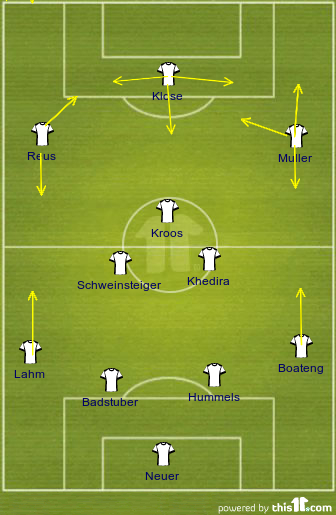 |
| 4-3-3 with Kroos and Muller coming into the side |
Overall, the clash between Germany and Italy looks set to be a classic, as it always is with both teams playing contrasting styles of football and having very equal starting teams in terms of quality. Both Prandelli and Low have shown their tactical acumen during this tournament and therefore the battle will not only be on the pitch but also on the sidelines.
*Statistics provided by www.whoscored.com

No comments:
Post a Comment