 |
| Pure Emotion: Gomez exorcises some of the demons of Euro 2008 |
Germany have come into the Euro's with a reputation far preceding that of the previous tournaments they played in the previous decades, virtually since 1998. The stunning downfall during the late 90's followed by the slow progression in the noughties meant that Germany were never considered as pre-tournament favourites, atleast beyond the cliche of 'never count out the Germans'. But now, Germany are definitely one of the favourites, earmarked as 3/1 to win the competition by betting agencies (behind Spain at 11/4). This change of reputation was clearly evident in this match and displayed by the tactics of Portugal.
Starting line-ups:
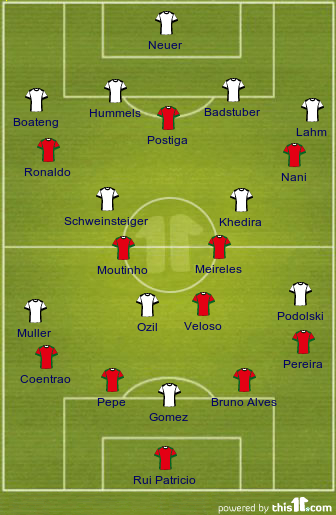 |
| Germany with a 4-2-3-1 while Portugal are more defensive with 4-3-3 |
It has been rare, over the past 10 or so years, to see a team with the reputation and attacking abilities of Portugal to start off so defensively. This is where we see the reputation of Germany playing into the mentalities of opposition teams. Paulo Bento's team has not been built on defensive solidarity, they had shown plenty of attacking presence throughout the qualifiers and in the friendlies prior to the final tournament scoring 16 goals in their 7 qualifying matches, while conceding 9 goals.
Much of the defensive attitude came from deployment of the trio of central midfielders, Joao Moutinho, Miguel Veloso and Raul Meireles. When compared to the trio of German central midfielders, Mesut Ozil, Bastian Schweinsteiger and Sami Khedira, it's obvious from first off that Portugal went against using an attacking midfielder to play behind the lone striker, Helder Postiga. Much of the work of the three Portuguese midfielders went towards defending their back line with Miguel Veloso having a set job of constricting Mesut Ozil whenever he was down the center, Germany on the other hand didn't really have a pure defensive midfielder. The defensive attitude of Portugal's three midfielders lead to Germany's controlling possession with ease as while Moutinho completed the most passes in his team with 39, all three of Ozil, Schweinsteiger and Khedira completed more than the FC Porto man, with a higher pass completion rate as well.
 |
| (c) UEFA.com |
 |
| (c) UEFA.com |
The defensiveness of Portugal made the opening half of the match quite tedious as Portugal sat virtually all 10 outfield players behind the ball regularly, therefore making it difficult for Germany to find spaces behind their defence. While it does seem as if Portugal is being given sole blame for the monotone nature match, it should be said that Germany themselves were quite unwilling to take risks with the fear of losing the match. The players mentioned that they had been watching the Holland v Denmark match prior to kick off and maybe the performance of Denmark ran a few doubts into their minds when considering a more attacking approach (not to forget Germany's recent 5-3 loss to Switzerland where they played virtually without regard for defence and were consistently caught out on the counter attack).
Portugal's use of Ronaldo and Nani and how it effected Germany's wingbacks:
With Portugal's central midfielders sitting deep most of the time, all of Portugal's attacks came from long balls to the Ronaldo and Nani, who were stationed on opposite wings. Most of the long balls were unsuccessful and counted towards Portugal's lack of possession in the opening minutes as Germany had over 60% of the possession in the first half while Portugal's passing percentage for the match was 78% compared to Germany's 85%.
 |
| Boateng vs Ronaldo. (c) UEFA.com |
The same can partially be said about Philipp Lahm down the opposite side. Lahm, being one heralded as one of the best attacking full backs in the world, was also a bit more restricted in his attacking movement as Nani was ever present in the wide right position.
 |
| Lahm vs Real Madrid (left, attacking from left to right) (c) ESPN Soccernet, Lahm vs Portugal (right) (c) UEFA.com |
A comparison between the two heat maps shows one clear difference which is a lack of presence in and around the box for the match vs Portugal. While Lahm was seen often attacking the by-line vs Real Madrid in the UCL Semi-Final at home, Lahm was, like Jerome Boateng, quite doubtful about his movement going forward as he stood the risk of leaving space for Nani to exploit. Lahm has usually been a vital part of Germany's attack over the years and therefore his lack of presence forward was clearly detrimental to Germany's chances of scoring a goal.
The Mario Gomez Conundrum:
It's rash to dedicate a section of the article to why Gomez should not start for Germany after what he did, which was essentially win the match but the point still should stand along with the point that he was going to be taken off had his goalscoring header gone off target. I posted an article seven months ago after Germany's win against Holland which illustrated the same issue and much of what occurred during the first 70 minutes of the Portugal clash only strengthened the argument for Klose's inclusion in the starting line-up.
Statistically, there is little to suggest that Klose should be in front of Mario Gomez. The Bayern Munich striker just ended a 41 goals season (following a 39 goal season prior) while Klose only managed 16 in half a season for Lazio as he spent much of the second half of the season on the treatment table. Even when you compare the Germany stats, Gomez does not stick out like a sore thumb since he scored six goals in six Euro 2012 qualifying matches. Miroslav Klose did seem to be Joachim Low's favourite for the strikers position during last season but the injury to the Germany's second highest goalscorer changed all of that with worries about his fitness leading up to the tournament.
While Germany gain a better goalscorer on the field when Mario Gomez takes the pitch in place of Klose, what they lose is the overall fluidity of their now famous quick passing system, a system that was shown to full effect in the friendly win against Holland. That fluidity is brought about when Klose takes up the lone striker position. As mentioned in the article, his partnership with Thomas Muller and Mesut Ozil form the core of Germany's attack and when that core loses a vital piece, it crumbles as it did against Portugal. Thomas Muller's movement is vital to that fluid system and while he is consistently seen moving into central goalscoring positions when playing alongside Klose, who is able to play well outside the box due to his better technique and passing abilities in comparison with Gomez, his movement becomes more restricted with the immobile Bayern striker in the center.
 |
| Muller vs Holland (left) (c) ESPN Soccernet, vs Portugal (right) (c) UEFA.com |
The reason both these images have been magnified beyond the usual resolution of the previous pictures is to emphasize the difference between the two. While they both do seem similar at first, one should notice the darker regions of the heat map vs Portugal and compare them to the more congested regions of the heat map vs Holland. It should be noted that Muller saw much more possession centrally and near the penalty box vs Holland than against Portugal, the main reason being the lack of movement presented by Mario Gomez in comparison to Miroslav Klose.
Conclusion:
So, in conclusion, it must be said that this match presented little variation in terms of tactics. While there were a few interesting points regarding Germany's cautiousness when using their wing backs, much of the match presented issues with regards to both teams that were already known such has Portugal's lack of a creative playmaker to play behind the main striker and Germany's lack of fluidity in attack when playing Gomez rather than Klose. The main question for the Germans heading into their vital clash with the Dutch will undoubtedly be whether to stick with the goalscoring prowess of Gomez or trust Klose's fitness and try to return to the quick movement and passing system which they displayed in all its glorious features against the Dutch no more than seven months back.

No comments:
Post a Comment