 |
| Lucien Favre and Marco Reus. |
Many have tried to digest as to why this has happened to the side that showed so much quality the previous season, the consensus points to manager Jurgen Klopp's tactics, which seem to be too offensive. Besides the fact that Dortmund had contributed to shooting themselves in the foot in the first few matches by missing chances at goal, they were consistently caught out on the counter attack, especially against Marsielle, whom they lost to 3-0 in France. This brings us to the current high flyers of the Bundesliga and potential UEFA Champions League competitiors next season, Borussia Monchengladbach.
After dispatching of local rivals, FC Cologne, 3-0 away from home, the side that had to fight off relegation through a playoff the previous season were on top of the league, albeit for only 24 hours after Borussia Dortmund's defeat of FC Schalke took them to top spot, only on goal difference. While Dortmund blitz through opponents in the first half of last season, Monchengladbach's performances have been quite the opposite. Dogged, Brave, Clinical have been words used to describe numerous victories from the giant of 70's European Football. The statistics support those descriptions as well, eventhough Monchengladbach are second only on goal difference, they find themselves joint fourth in the 'Goals For' column with 23 goals (8 of which have come in the last two games) but what has made their season what it is is that Lucien Favre's side have conceded the second least goals this season, only behind Bayern Munich.
Lucien Favre: The Right Man for the Job
When Favre was appointed the manager of Monchengladbach last season, many were thinking that it was a lost hope, such was the state of the club at that moment. With 21 match days having passed by and only 13 more left, Monchengladbach were in last position, six points behind the play off spot and leaking goals, 53 to be exact, 10 more than anyone else. What was also interesting to know was that the same team had also scored 31 goals, therefore showing where their strength lied and where to rebuild first. The young side had always shown traces of their ability to take on the leagues biggest sides, non more so than on the occasion when they defeated Bayer Leverkusen 6-3 away from home.
Favre was unemployed after being taken off by Herta Berlin, a few months after he lead them to an unexpected fourth place. Berlin were never the easiest on the eye, they didn't have any star players to name nor any skillful ones. Their strength was in their ability to hold the fort and get the few goals needed to get the points. 41 goals conceded was the third best defensive record for the season, the 48 goals they scored was closest to the least goals scored rather than the top of the table. With Gladbach's individual talent up front, any coach's main job would've been to sort out the terrible defence. Therefore, with his previous experience with Herta Berlin, Favre knew exactly how to handle the situation.
The Formation: 4-4-2
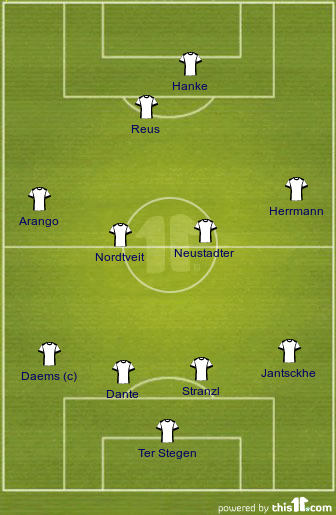
Midfield and Striker Pressure In Midfield:
Monchengladbach are a hard working side, and non more so than the attackers. With Monchengladbach's much documented frailities in defence last season, the back-line were in need of as much help as possible. While Michael Frontzeck, the previous manager, was not able to get the wingers and strikers as part of the play off the ball, Favre managed to feed his hard working nature into his players.
 |
| Heat Map of the two strikers vs Bremen (c) Bundesliga.de |
 |
| Reus (11), Hanke (19) ground challenges vs Bremen (c) Bundesliga.de |
With mention of hard working players, Mike Hanke and Marco Reus are sure mentions. Despite playing as strikers, they are, as seen by the pictures of their heat maps and challenges, very committed to playing deep and helping the midfielders win the ball and break forward. Its not only the two strikers who are committed to helping out defensively, Lucian Favre has done wonders in getting the wingers to help out as well, most notably Juan Arango. Since the arrival of the Venezuelan, his qualities on the offensive end have been easy to pick but what was also easily visible was his lack of effort off the ball. Alongside Arango, the younger and more vibrant Patrick Hermmann has been doing a similarly good job at helping out his slightly older compatriot at RB, Tony Janschtke.
 |
| Arango, Jantschke and Nordtveit (all red) close down Arnatouvic deep in their half. |
In the above screenshot, taken from the recent 5-0 victory against Werder Bremen, all 10 Monchegladbach out field players are in their half defending, out numbering the attacking, and losing, side by three and keeping an eye on close-by opponents in order to take out any time the Bremen players might have on the ball. Not only are there three players surrounding the man in possession, but also we have Reus and Hanke (both in white) sitting very deep. Not only does that help in preventing Bremen from restarting possession by passing back to their defenders but that also enables them to instigate their biggest weapon thus far, the counter brisk counter attack, which Monchengladbach have perfected under Favre. Not coincidentally enough, this pressure on Arnatutovic and subsequent loss of possession for Bremen lead to Monchengladbach's second goal with Reus and Hanke combining before the former brilliantly dribbled through the Bremen defence and scored.
Pressure in Midfield leads to Brisk Four-Man Attack:
With Arango, Herrmann, Hanke and Reus sitting deep, Monchengladbach are built by position for a transition attack, from defence to attack with the blink of an eye. As mentioned earlier, Monchengladbach do not score many goals, but they score enough to win. Of the nine victories they have recorded this season, four have been 1-0's while two more victories have been by a single goal. It is only recently with the two wins against Bremen and Koln that Favre's men showed their potential for brutal attacks. Their offense can be categorized as the four man show of Monchengladbach's two wingers and two strikers with the midfielders and wing backs rarely being involved (besides the rare foray forward from Neustadter).
Here is a short video illustrating the fantastic combination between Monchengladbach's attackers since Lucien Favre has taken them over:
The attack is built on the technical abilities of Monchengladbach's attackers. Whether they be likely starters in Reus, Hanke, Herrmann and Arango or the substitute's like De Camargo and Bobadilla, the ability of the players to perform one touch passes has refined Monchengladbach's attack to one which rare opts for the long ball option when attacking. Even when losing 1-0 against Schalke, Favre's outfield players only attempted 14 long passes from a total of 440 passes, a percentage of 3.18, compare that figure to that of Bayern Munich vs Borussia Dortmund in their recent 1-0 loss, the percentage was more than four times as high (13%). * The combination of persistent pressure in midfield and a short passing game mean that Monchegladbach hold, on average, 54% possession per game, the third highest in the Bundesliga behind the usual culprits, Bayern Munich and Borussia Dortmund. **
Disciplined Defence: The Two N's and Banks of Four
As mentioned above, Monchengladbach's two central midfielders, Roman Neustadter and Harvard Nordtveit, are rare contributors to the teams attack. Their primary objective is to support the defence and prevent the opposition central attackers from getting any room and space to conduct attacks. Both players have been fully integrated into the system by Favre. While Neustadter has been part of Monchegladbach since leaving Mainz in 2009, it was only till Favre came in did he start to consistently find himself in the starting line-up. His defensive awareness and energy along with a knack of getting forward at the right time enabled him to be the perfect defensive box-to-box midfielder for Favre's formation. The 23 year old's supporter in midfield is former Arsenal youth player Havard Nordtveit, a player first brought into Germany through a loan deal by Nurenberg, he was signed in January 2011 and has been an instant hit for Favre. A more defensive player, he usually presents himself as the deeper of the two midfielders.
 |
| Nordtveit (16) and Neustadter (13) passing vs Bremen (c) Bundesliga.de |
Both men present decent tackling statistics (Neustadter: 299 challenges, 52.6% won on ground, Nordtveit: 157 challenges, 51.5% won on ground) * though in comparison to other defensive midfielders in the league, they lag behind. That is a prevalent theme throughout the Monchengladbach defence, going through the line-up their isn't one star name that immediately pops out, yet they find themselves with the second best defensive record. Its all down to the discipline brought in by Lucian Favre; discipline that was clearly lacking during the tenure of the previous manager.
 |
| Two lines of four with Hanke (white) also deep vs Cologne *Reus was off the field at this moment* |
The two lines of four, first being the four defenders and the next infront being the two midfielders and two wingers, has been a persistent theme with Favre and Monchengladbach. This simple formation illustrates how Favre has been able to get this defenders and midfielders to co-operate and form a cohesive partnership. Another impressive feature of the two lines is how they are able to move together according to in which area of the field the ball is present, therefore narrowing the area of possession and forcing the opposition to try and hit difficult balls either over the top of the defence or out wide (as seen in the picture of the match against Bremen).
How far will they go?
Monchengladbach have already played against some of the best sides in Germany and have more than held their own, defeating Bayern Munich in the first match of the season was a superb achievement and their performance against Leverkusen in the 2-2 draw clearly showed that they are the superior side in front of their local rivals. Their solid defence has been their shining armour this season and has yet to crack even against the best offensive sides in Germany. Up next for them though is a team that has whose attacking prowess is respected throughout Europe, Borussia Dortmund. There are similarities beyond the name, both like to keep possession but as mentioned earlier, Monchengladbach are much more comfortable playing the counter attack game. It will surely be their toughest test yet.
Monchengladbach are most likely going to be without Marco Reus for the match, which will provide a good litmus test to see how Favre's side will cope next season for it seems very likely that they will be losing their star man in the upcoming summer transfer window. In regards to this season, Reus seems set to stay the distance and if Favre wants to have any hope of accomplishing the near impossible at the start of the season, qualifying for the UCL or even better winning the Bundesliga, then it is paramount that the 22-year old all round winger be fit for the rest of the season.
* Statistics from Bundesliga.de
** Statistics from Whoscored.com

This article is very good! Epic introduction for budding tactictiens and FM enthusiasts!
ReplyDeleteIt's a poor man's version of Sacchi's AC Milan. Two banks of four, a high line, and pressing starting from the front.
ReplyDeleteDoes that mean Reus is a poor man's version of Van Basten? As a Germany fan, I would love even that much!
ReplyDeleteI would love to see more matches of Sacchi's Milan since it was before my time of watching footall.
I just recently discovered this blog and I love it. I love blogs that focus on formations and tactics, but I'm curious where you are getting the maps for passing. I found the heatmap on the Bundesliga website. Those maps look similar to the chalkboards that are available from The Guardian for Premier League, but I'd love to find the one for the Bundesliga
ReplyDeleteIts a bit long but since you have found the heat maps on the Bundesliga website I guess you have reached the match 'matrix' page. From there, you can select any number of players and from there scroll across the area in the middle to the 'Pass' box. Select that and you'l get the pass map, 'Kurz' means short, 'Lang' means long, 'Angenkommen' means successful pass, 'Nicht Angenkommen' means unsuccessful.
ReplyDeleteHope that helps.