 |
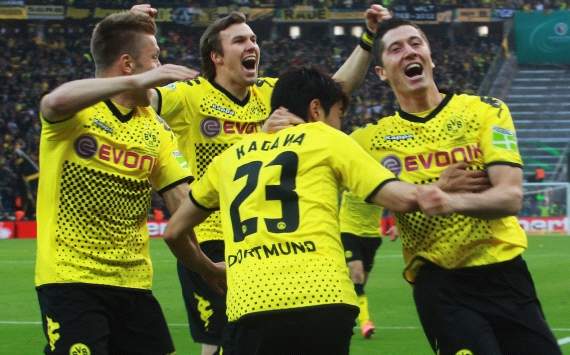
| Dortmund players celebrate their DFB Pokal final win over Bayern Munich, Chelsea's Champions League final opponents |
A Point-wise overview:
Football tactics can be very complicated, from the early days of the run and chase on the muddy waters of Scotland and England to the ideas of the False-9 implemented on the training grounds of Barcelona. It would be a terrible disgrace to the work of Jurgen Klopp to
think that his detailed idea of playing can simply be put in a few points but there are a couple of fundamentals that should be noted, the details and evidence of which will be provided later on.
1. Extreme Work Rate
2. Concentrate on quick passing and movement while in attack.
1. Extreme Work Rate: Lessons from Real Madrid's Lose and Dortmund's Success
 |
| Dortmund's midfield work horses, Bender (l), Kehl (c), Gundogan (r). Essential to their triumphs |
But such is the overall commitment of Jurgen Klopp's side that their willingness to cover ground is not restricted to just their defensive midfielders, as we'l see when we take a look at the distance covered statistics of Dortmund's wingers (Gotze, Grosskeutz, Kuba). Again, by tabulating the average in the two league matches we see that Dortmund's wingers ran 12.13 km's per game while in the one match in the Champions League, Real Madrid's wingers ran just 11.2 km's on average together (much of which has to do with Ronaldo's pale effort of 10.7 km's while Di Maria put in a quite good shift).*

 |
| (c) ESPN Soccernet |
 |
| (c) ESPN Soccernet |
 |
| (c) ESPN Soccernet |
This aspect of Dortmund's game is more difficult to illustrative using diagrams and graphs, especially when wanting to differentiate between two teams style of play. The key to Dortmund's attack is not necessarily their ability to hold possession, though winning the league they are third in the possession standings behind Bayern Munich and Monchengladbach, but their effectiveness with it thereby making them a more direct threat than team. It's surprising to see that though they hold the third most possession in the league, their passing completion percentage is joint fifth while having scored the joint most fast break goals. Bayern Munich have been labelled as somewhat of the anti thesis to Dortmund in that their style of possession football is slower and more patient, much like being the Barcelona to Real Madrid, and can therefore be stifled against a disciplined defensive system like Dortmund and Borussia Monchengladbach.
Bayern Munich have also being accused of being too dependent on Mario Gomez for their goalscoring and Rob-bery (Ribery + Robben) for playmaking. That accusation can hold some truth when the stats are looked at and compared to a team like Dortmund. While Bayern Munich's top three goalscorers (Mario Gomez, Robben, Ribery) scored 65% of their team's 77 goals in the league season, Dortmund's top three scorers (Lewandowski, Kagawa, Grosskreutz) contributed just 52.5% of the champion's 80 goals. Similar numbers can see seen for the assists count, not only does Dortmund contribute a massive 13 more assists (65 to 52) but their top three assist givers (Kagawa, Kuba and Lewandowski) share 40% of the load while Bayern's top two, let alone three, (Ribery and Kroos) share the same percentage. Its important to notice that Kagawa and Lewandowski are present both as Dortmund's best goalscorers and goal creators.
Similar stats for Real Madird (74% goalscoring, 47% assists) and Barcelona (63% goalscoring, 47% passing) show how much of a teamwork oriented side Dortmund are in offence in comparison to the top sides in Europe. Much of this sharing amongst goalscoring comes from Dortmund's movement within the front four of Grosskreutz, Kagawa, Kuba/Gotze and Lewandowski, a lethal partnership which proved to be very vital to defeating and outperforming Bayern Munich this season. The variety of goalscorers and goal creators means that defender's can't focus on a single attacker while they are also prone to being thrown out of position while marking the wingers moving into central attacking positions.
So, what tactics do Chelsea use?
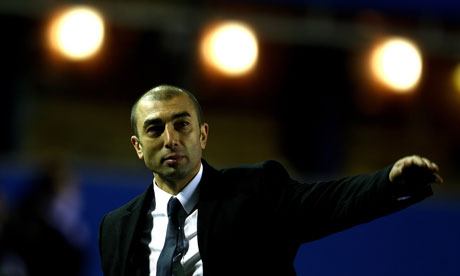 |
| Roberto Di Matteo has brought a different tactical view to that implement by earlier boss, Villas Boas |
While looking at Chelsea from a tactical perspective, it would seem likely that they'l walk in with a defense first mindset, similar to the one they used to beat Barcelona though one would expect not so obsessive, this could seem the way forward but one should also expect a different challenge presented by Bayern Munich to that of Barcelona. While Bayern Munich are akin to Barcelona in that they like to hold large amounts of possession the presence of Ribery and Robben and, for the final, Thomas Muller, presents a much more direct threat to that which was seen by Barcelona as the Catalans have not played with a natural striker in their system since the leg injury to David Villa and usually play with only one natural and direct winger, Alexis Sanchez.
All out Defence ala Mission Nou Camp:
Though Chelsea did come out of the Nou Camp with the result needed, it should be noted that they conceded twice (though one was with 10 men) and the only reason they did not lose the leg was because Barcelona were behind on goal difference and threw everyone forward prior to Chelsea's second. Credit should be given though to Chelsea for holding their opponents to zero goals in the first leg and for the second half of the second leg, the question then boils down to whether Chelsea should continue with this for the final. There are a few problems that do look like arising through if Chelsea do look to play very defensively.
As stated before, Ribery, Robben, Muller and Mario Gomez present a much more direct threat to Chelsea's goal than Barcelona's attacking four of Messi, Iniesta, Fabregas and Sanchez. Direct in the sense that those players are more likely to try and attempt to dribble past opponents when presented with the opportunity to rather than play a pass, Gomez's directness comes from his ability to move into space within the box. Though Ineista was neutralized very well by Chelsea, he did take up possession very close to in and around the box, though always surrounded by blue. The main difference between the two can be seen in this situation where one would expect Ribery to try and attack this marker by using his superior speed and dribbling ability while Ineista would be more prone to pass the ball back to his fellow midfielders and look to reset another attack.

Ramires' absence will be most crucial to Chelsea for that, eventhough Drogba got a lot of plaudits for his performance, he was the most important attacker in the Chelsea side. It was his run from deep that created Drogba's winner in the first leg while his goal, created again from a very similar lung bursting run from deep in midfield, in the second leg have Chelsea a vital away goal advantage. From the remaining pool of central midfielders within Chelsea's line-up, Raul Meireles would've been seen as the next most energetic midfielder so his absence will prove to be key in that respect.
It should be remembered that Bayern have their own suspension problems with Holger Badstuber, David Alaba and, most importantly for this section, Luiz Gustavo out of the final. Luiz Gustavo's special mention has been given for that without his presence, and that Bayern Munich's other defensive midfielder, Anatoly Tymoshuck, will be playing center back due to Daniel Van Buyten's injury and Breno's arson arrest, Bayern Munich will be without a pure defensive midfielder with Schweinsteiger and Kroos taking up the deep central midfield roles. If either Ramires or Meireles were playing, this gap could've been exploited since the central midfield pairing of Schweinsteiger and Kroos has seen it's share of defensive frailties not only last season (as mentioned in this article) but as recent as the Pokal final against Dortmund.

On the left frame we see Kagawa in yellow being left completely unmarked by Kroos as Schweinsteiger is on the offensive. The following frame arrives a few seconds after Schweinsteiger's shot is blocked and Kagawa now has possession of the ball with only the two Bayern center backs (out of shot) in front and defending him with Kevin Grosskreutz (yellow) racing forward ahead of Lahm to support him. This counter attack lead to Grosskreutz playing in Lewandowski who scored Dortmund's fourth.
Chelsea's goals against Barcelona came under fairly similar circumstances as Ramires was unmarked by Barcelona's midfielders and defenders as he strode forward with speed, quick enough that no one was able to catch him. Its difficult to see whether either of Frank Lampard, John Obi Mikel or Michael Essien (or even Romeru) will be able to provide the same energy breaking foward. This therefore is certainly a missing point for Chelsea if they are planning to continue to the same tactics as those used against Barcelona. In order to create chances, Chelsea would need more support from the wings than what was shown in the two matches against Barcelona.
Using Dortmund's example: Can it be done?
After Dortmund's 5-2 win over Bayern, there have been a few people who've stated that Dortmund's performance shows that Chelsea can beat Bayern if they carry forward their Barcelona tactics as if to say they are similar, but is far far from the case. As stated above, though Dortmund themselves held low amounts of possession vs Bayern, their style of play was much different from that of Chelsea and can not be labelled as a purely 'defensive' approach. We saw from an earlier heat map of Iniesta that he was allowed a lot of possession in an around the penalty area (from the second leg) while one of Ribery showed him being restricted further, and wider, away from the area. The reason for that being Dortmund's defensive tactics involving compactness of the playing area with their defense pushes forward while their attacking pull back in order to squeeze the space while Bayern are attempting to build attacks, similar to Barcelona's relentless pressing. This usually forced Bayern to try long balls over the top rather than playing their way through opponents like they prefer. With a season average of around 14% of their passes per game being long balls, Bayern attempted numbers jumped up to 18% when they played against Borussia Dortmund, a figure of 11.5% is seen when we look at their match against Real Madrid on the other hand.
The difference in the level of pressing that Dortmund showed against Bayern to the extremely deep line adopted by Chelsea can be seen when we look at the heat map of the both teams completely (the Dortmund heat map has been reversed so that both line-up on the same sides. The Chelsea graph is from the first leg v Barca while Dortmund's is from their 1-0 win at the Allianz Arena).
 |
| (c) ESPN Soccernet |
Chelsea's ability in attack: Long ball vs Dortmund's quick passing.
Didier Drogba's form has been instrumental in Chelsea's charge towards the final and he will most likely be extremely important come the final once again. Using a player like Drogba with a largely defensive mindset renders Chelsea's attacking game to be different from that used by Dortmund during their clashes with Bayern. But that's not to say that the tactics won't be more effective. With center back Holger Badstuber suspended for the final and Daniel Van Buyten having not playing competitively since January and fighting against time in his race for fitness for the final, it looks very likely that the 5' 11 Tymoshchuk will be playing center back alongisde Jerome Boateng and that immediately indicates an aerial weakness for Drogba to exploit. We had seen Drogba try the same against Masherano but the problem arose as Chelsea's long balls were not accurate enough on most occasions, ironically it took a quick passing move to break down the Catalans in both legs. Even then, this is definitely an area where Chelsea can hold a strong advantage.
In regards to the question as to whether Chelsea can try the quick passing manoveurs of Dortmund, the case doesn't seem likely. Chelsea have scored just 2 goals categorized as 'counter attack' goals compared to Dortmund's 11, which shows the vast disparity between the two. Chelsea will also be lacking the running ability of Ramires and Meireles in the center, both of whom could've been very effective for launching quick counter attacks through middle where, as stated before, Bayern Munich have a defensive weakness. Juan Mata though will be a vital weapon in attack but will have to display the energy he showed against Valencia, and not the completely defensive attitude shown against Barcelona, if he wants to be most effective on the day, on both ends.
What will happen in the end?
The article does picture a gloomy state of affairs for Chelsea. While Chelsea can boost that they've just knocked out one of the greatest sides in the history of the sport, the host of absenses, especially that of Ramires and Meireles, means that they are significantly weaker. Scoring three goals against Barcelona, given their complete lack of possession, is impressive but one has to remember that Ramires was at the heart of two of the goals and without his running, and the lack of the proper replacement, will mean that they will be without a big offensive weapon. The season has shown that neither Lampard, Mikel or Essien can recreate that energy.
So offensively Chelsea are down a vital man, defensively they will be coming across a slightly different type of team then that of Barcelona, different only on the flanks. Ribery and Robben are much more direct players in comparison to players like Iniesta and Fabregas and therefore dealing with them will require different tactics. Dortmund have shown those exact tactics over their past five meetings with Bayern but Chelsea will have a problem recreating those tactics due the lack of players willing to put in the miles required to complete the job.
This, though, is football after all. Anything can happen on the day. Bayern Munich have lost 9 times this season, again only 2 at home though, so they can have a bad day while Chelsea's players will have a lot riding on this match since this is their last hope for a Champions League place next season, so we might see a performance beyond the odds from them.
*Distance covered statistics for Bundesliga matches taken from www.bundesliga.de. Distance covered statistics for UEFA Champions League matches taken from uefa.com. After looking at a few matches, it does seem that UEFA's stats can be slight overstated.
**All other stats have been taken from www.whoscored.com

This comment has been removed by the author.
ReplyDeleteChelsea don't have the personnel to play the Dortmund way. What they do have is desire and courage, those seem like the only traits that pulled them through the Barca tide. I expect it to be a tight game. It could go either way. It could even end in penalties. Lot will depend on how Chelsea defend with half-fit centre-backs and a poor right-back in Bosingwa. Munich too would be weakened at the back as a result of losing key men. Both teams have much riding on this, Chelsea more so than Munich.
ReplyDelete