 |
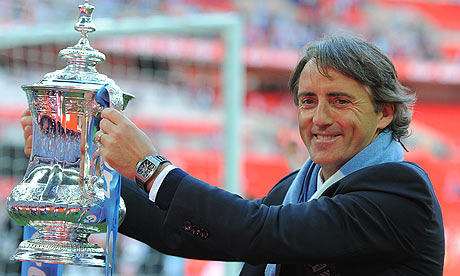
| You can have this, Alex, Vincent said that we still won. |
As much as the neutrals would want to emphasis the impact of Chris Foy's controversial red card to Kompany, they shouldn't be blind to the fact that he missed an utterly blatant penalty decision in favour of United when Kolarov brought down Antonio Valencia, ironically it occurred at 3-1 and barely seconds before Manchester City got their second goal. 4-1 and I wouldn't even be writing this article. But, what's done is done and Manchester City did get their second and though being a man down continued to force Manchester United back until the final whistle. It was a valiant 600 Million Pound (I have to show some allegiance), minus the six million for Vincent Kompany, effort that came about from some great decisions from Mancini along with a poor one from Sir Alex.
How the match started:
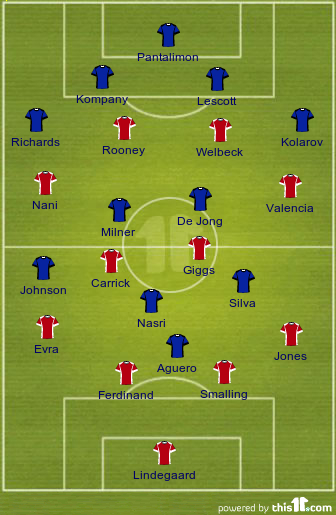 |
| How the two teams lined up at the start |
Manchester City have always been a side set up to dominate the center of midfield by having a very narrow formation and today wasn't difference. Some could say that Mancini had planned this formation due to United's struggles against Newcastle's midfield duo of Cabaye and Tiote in their 3-0 loss to the Magpies just a week earlier, but the formation set up was not far from the ordinary. Yaya Toure, unavailable due to the AFCON, and Gareth Barry, suspended after his red card vs Liverpool, were the noticeable absentees in midfield for the Blues; with Milner, a regular for the big occasions for Mancini, and De Jong taking duties instead.
Manchester United looked refreshingly almost full strength after almost a month of horrid injuries forcing a back-line with Valencia usually occupying the right back role and Carrick as one of the central defenders. Sir Alex Ferguson surprisingly went for the same central midfield which was embarrassed by Newcastle's, though injuries did not make his choice much of a dilemma. Valencia returning to his familiar role of right winger would be a huge boost given the weakness' of Kolarov and the lack of support offered by either Silva or Nasri down that side.
City dominate, concede and are then 'Foy'led:
Early proceedings did follow much of the pre-match expectations with Manchester City having majority of the possession due to their dominance in the centre. Silva's presence in the center along with that of Nasri making it a 4 man central midfield in face of Carrick and Giggs who were clearly overwhelmed. While Manchester City have always looked stronger in the center of midfield, their narrow formation has always been supported by the width offered by their wing backs, Micah Richards down the right and either one of Kolarov or Clichy down the left. With that tactic and the lack of support usually given by their midfielders, City have been been attacked regularly down the flanks with long crosses but that has been countered mostly this season with the large presence of both Lescott and Kompany in the center of defence usually making haste of any crosses entering the box. That tactic though back fired, not once, but for both goals for Manchester City.
 |
| Before United goal: Valencia in acres of space with Kolarov pushed in due to Welbeck's run and Silva not supporting. |
 |
| Valencia (red) tracks Kolarov's run. |
2-0, 3-0, Could it be 6-1?
The match looked to change little with the substitution as Manchester City continued to dominate possession but Manchester United counter attacking with menace down either wings. Inevitabley, they would take the lead through another wing attack. Careless positioning from makeshift rigth back, Milner, meant that Evra had acres of room to play a dangerous cross, a cross which while not directly, did contribute to the Welbeck's fantastic goal. A third goal arrived soon after with a stonewall penalty given for a rash tackle by Kolarov on Welbeck. Rooney's saw his penalty saved by but, through the telekinetic powers of Chris Foy, the ABU's would have you believe, the ball managed to fall right back to him for the simple tap-in header. From hoping for not being on the receiving end of another hammering from their rivals, United fans now thinking about talking about settling the score from their defeat at Old Trafford.
The Second half. Mancini shows his quality while Sir Alex shows his age:
No one would've given Manchester City an inch of hope when they the first half whistle rang and their ten men walked back into the dressing room looking despondent and bereaved of any confidence of a comeback. It was going to take a miracle but Mancini showed that it could also take a bit of ingenuity to put Manchester City back into the game.
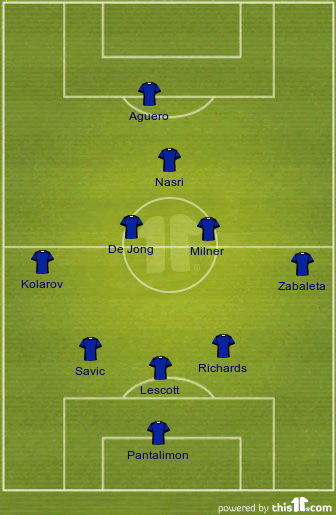 |
| Tactical Change: 3-5-1 |
The first noticeable change was the 5 man defense. With United clearly coming out of the first half on top, there had to be more solidarity and, more importantly, a better recognizable defence. With Milner's lack of defensive ability brutally exposed for the second goal. Mancini sought out to being more established defenders in Savic and Zabaleta. Zabaleta moved into the right wing back position while Milner moved into his more comfortable central midfield position. The attack consisted of a the sole striker, Aguero with a 3 man midfield of Nasri, Milner and De Jong.
The change to a 5 man defence certainly did help Manchester City draw the curtains on any Manchester United attacks. While United consistently took advantage of their strength wide of the pitch in the first half, the presence of Zabaleta and Richards down the right side while that of Kolarov and Savic down the left meant that the Red Devil wingers were not offered as much space near the box as before. De Jong and Milner also consistently dropped deep in order to support the defence and mark the deep running of Rooney and Welbeck. United's hold on possession was strong, but their chances from that possession were minimal, a stark opposite to what occurred in the first half.
The importance of having two players in Zabaleta and Kolravo on the wings is the balance of defence and attack they give and the high stamina they maintain. Both were the perfect choices for the wing back positions as they helped City prevent United from completely sealing the game and were also eager to race forward, capably, to support the attack. Manchester City's main ploy was to let United hold possession, bring them forward and hold the chance of hitting them on the counter throw the energy of Zabaleta and Kolarov. It was through a counter attack that Manchester City did end up scoring their first goal, albeit not from a run from either wing backs but Micah Richards who burst through the midfield and forced a miss timed tackle from the every vigilant Valencia. Kolarov scored from the resultant free kick to give Manchester City a glimmer of hope.
Game, Set, Scholes?
Maybe it was due United's tendency to being caught on the counter or maybe Sir Alex thought that even at 3-1 the match was done and dusted, but the move of bringing on Paul Scholes was one of huge surprise given the United legend had not played even a reserve game for over 6 months due to his retirement. Even if Scholes clearly did not have the legs to compete against the Manchester City midfield of De Jong and Milner, his class in possession meant that he was still able to control possession, which was ultimately what Sir Alex was hoping for; someone to slow the pace of the game.
But it was always going to be debatable whether Manchester United should've tried to continue to pressure Manchester City or just try to see they game out like they did. They say the ultimate weak point of the 3-5-2 formation is its dependence on the wing backs to go forward and support the attack, that dependence can be curtailed from a formation making use of attacking wingers who can push the wing backs into defensive positions and prevent them from moving forward with freedom. Manchester United did have a wide formation for much of the match with Nani and Valencia making full use of the space afforded to them on the wings.
One aspect of United's width was taken off though when Sir Alex made the change to bring on Paul Scholes for Nani, thereby moving the now natural central midfielder Ryan Giggs to the left wing, something of an oxymoron since Giggs was hardly seen in wide positions. Having both Giggs and Scholes thereby allowed United more dominance of possession though without the same potency as before. City looked more comfortable while defending but now had more space down the right to push forward on the counter.
With all this being said, the second Manchester City goal had little to do with tactics since it came through a combination of errors from Manchester United, first the poor touch from Scholes, then laziness from Evra ended with a poor save from Lindegaard offering Sergio Aguero a simple tap-in. With the score 3-2, everything was working perfectly for Mancini while Sir Alex's substitutions looked to have back-fired.
The Blues had little over 25 minutes to get the third and force the match into extra time and they looked increasingly dangerous against a United side which became more and more nervous. The tactics for both sides remained the same but with United's players tiring, City's counter attacks gained more momentum with each passing minute. The pace and skill of Aguero was key throughout the second half as the little striker constantly terrorized the United defence with his running ability on with the ball and skill. Due to his lack of height, Manchester City could not work their tactic of crossing the ball into the box as they would with someone like Dzeko in the side, the tendency to work the ball into the box rather than crossing it worked well for City though as their pace through the middle troubled the likes of Carrick and Scholes who could not match their rivals in a sprint.
City's pressure late in the game did not pay off though as they could not find the final goal to complete their comeback. It was still a valiant effort they would surely be proud off looking back at. Mancini has been undermined in the media and by fans before due to his record of winning trophies with sides either with a handicap over their opponents (Inter Milan being considerably stronger than their rivals) or with a huge bucketload of money. He did show signs of the tactical ability he has by changing City's system and making an fist fit of a situation that looked like a sure knockout. Sir Alex's change to bring on Paul Scholes back-fired since it took the pressure of the Manchester City defence and enabled them to attack on the counter more regularly.

No comments:
Post a Comment