 |
| Similar to Tevez's arrival in 2007, Welbeck's return has seen a new verve about United's attack |
After only scoring eight goals in their previous seven matches, United walked into Switzerland to face FC Basel with their offense faltering. After what happened in the next 90 minutes, the only positive that fans could take from Basel was that there was very little chance that United would get much worse this season. Only managing a scruffy goal with a few minutes remaining the match, United's offensive performance could've been rated as one of the worst in recent memory. If there is one constant praise of Manchester United throughout the ages Sir Alex Ferguson has been in charge, it is that they're great at reacting to adversity. You don't have to go far back to see the last example of this sudden rejuvenation for it was only immediately following their Champions League group stage exit in 2005 that Manchester United went on to win three consecutive Premier League titles along with a Champions League trophy in 2008.
The 2007-2008 season will go down long in the memory of United fans for there have been few seasons that have provided a combination of exhilarating football and unprecedented success. While the current season will not go down the same route in terms of success, there are signs of progress towards the same attacking football that excited crowds. Following United's debacle at Basel, United fan's optimistic thinking of their performances only getting better has become justified but the amount by which the performances have improved has surprised many.
Danny Welbeck brings out the better memories of Carlos Tevez:
There was a lot of difference in the line-up that played against Basel and those that took to field against Wolves, QPR and Fulham over the previous week. Therefore some might just put this resurgence of form as another case of Sir Alex managing to rally his troops back to their senses but there not being a lot of change doesn't mean that there hasn't been an effect from that respect. One change, or returning player, in particular has struck out and when you look back at the start of United's poor offensive run and realize that it coincided with the departure of said player, first from his favourite position and then subsequent injury, you come to think that there could be more to this resurgence of form than just a hair-dryer from ol' Sir Alex.
 |
| One of the happier memories, Tevez scores his first United Premier League vs Chelsea at Old Trafford |
Manchester United started off the season in brisk fashion, following the superb 45 minutes at Wembley that saw them dismantle Manchester City's defence in route to a come back 3-2 victory, Manchester United set about scoring five goals in their first two Premier League matches in lead up to their clash against Arsenal. Now while in truth Arsenal's defence and midfield was at there second string level at best, United's dominating 8-2 victory showed that following a rather dull, though successful, 2010-11 season, United's offense was back on track to becoming the exciting entity it once was in the middle of the previous decade.
Young England International and Manchester United youth product Danny Welbeck had returned to Old Trafford on the back of a successful loan spell at Sunderland where he managed six goals in 21 starts. What was more encouraging for United fans though was that majority of his goals came during a period where manager Steve Bruce opted to play Welbeck as a floating striker alongside either Darren Bent or Asamoah Gyan. Injury curtailed what was looking like an impressive run of form for the youngster but he had made enough of an impression on Sir Alex. A particularly impressive performance from Welbeck came against Chelsea at Stamford Bridge, a match Sunderland amazingly won 3-0 with an exhibition of quick passing that opened up Chelsea's lethargic defence.
 |
| Left: Welbeck v Chelsea (A) 2010-11; Right: Tevez v Chelsea (H) 2007-08 (c) Guardian Chalkboards |
Welbeck's free roaming performance against Chelsea was one which caused major problems for the opposition defence. His display of clever off the ball running and a willingness to play one-two passes was a show of creativity and attacking talent that wasn't expected given Welbeck's struggles prior while playing mostly as a winger, not surprisingly given that Welbeck had flaterrerd to deceive while playing a similar role for United in cup matches the previous season. The match was proof of the Welbeck's far superior ability as a forward rather than as a winger. His role of as a deep striker bore resemblance to that of Argentine Carlos Tevez during his first season at Manchester United in 2007-08, an integral part of United's great attack that season.
Coming into the new season, Welbeck, inspite of the presence of Javier Hernandez and Dimitar Berbatov, was given the role of playing alongside Rooney in Sir Alex's 4-4-2. His immediate performances were exciting. Playing slightly deeper than his English compatriot, Welbeck's versatility was an winger came into effect with movement off the ball that confused opponents just as to how to mark him. United's offense seemed quicker and more fluent with bursts of short passing which caused much havoc. That flamboyancy about United seemed to slowly disappear, first following Rooney's move into the center of midfield against Sunderland and Everton, thereby moving Hernandez as striker and Welbeck as a left winger as part of a 4-2-3-1, and then following Welbeck's injury while on international duty.
Poacher Hernandez vs all round Welbeck:
During those injury periods for Welbeck and Rooney's short spurt as a midfielder, Javier Hernandez was brought in as the striker alongside Wayne Rooney. While this article might seem a bit critical of Javier in the way of being pro-Welbeck, it should be stated that United would not be as close to Manchester City in the table as they would without the goals from Hernandez. His goals in United's 1-0 victories over Everton and Swansea along with his equalizer against Liverpool and goal against Newcastle in their 1-1 draw have all been vital thus far.
While it might seem obvious to a more regular viewer of United's matches, many neutrals to the English game might not know the difference between the styles of play between Welbeck and Hernandez. They might also be wondering why, with all the reputation Hernadez garnered for himself last season, Welbeck is Sir Alex Ferguson's first choice striker. The answer is simply in the comparison of the ability both players have on the ball and the effect it has on the teams passing movement. Not only that but United's overall tactics take a significant turn when Hernandez is in the line-up. With Hernandez in the line and with his ability to make runs of the last defender, United are more prone to playing with a wider, counter attacking philosophy rather than building up attacks through quick passing and movement which you would normally see while Welbeck is on the pitch.
Hernandez's role in the link-up play before United's goals is minimal and, more importantly, less than Welbeck, on average; Welbeck attempts 28 passes per game compared to 18 for Hernandez. That is an area where we can see development over the last year for Hernandez though.
Nani, stepping into Ronaldo's role:
Its difficult to wonder whether Sir Alex Ferguson ever thought of Nani as a long term replacement for Cristiano Ronaldo. The age difference was only one year when Nani was signed while Ronaldo was happy and jolly at the club, add to the fact that both players played in opposite positions so Nani was not going to directly set into Ronaldo's position if the reigning English Player of the Year had left. When the time did come for Ronaldo's departure, all eyes were set on Nani to replace the 118 goals Ronaldo scored during his time at United. The going was tough at first to say the least.
But alas, after years of frustration it seems as if Nani is finally settling into the world's expectations. Last season was by far his best, scoring nine goals and assisting a league leading 18 goals and this season has been just as productive with 6 goals already in 17 appearances along with 8 assists. While the assists stats are impressive, what Nani is doing now, which is getting him close to replacing Ronaldo, is scoring more goals. Confidence and adaptability to league are the major reasons behind this reign of form.
Most of Nani's good form for United the previous season had come while playing as a right winger rather than his original left winger position. From that area he was able to use his trickery and speed to greater effect in order to find space to whip crosses in. Along with that ability, his strength with the left foot meant that he was able to double guess his marker and sometimes shift to his left boot if he was being marked down his right side. Thus, with the added potential of attacking the by-line and playing crosses across the face of the goal, Nani added the ability to move centrally and become more of a goal scoring threat, something which was ultimately what took Ronaldo from being a talented winger to one of the best players in the world.
The last two images are of right wingers with the middle picture showing Nani's passing map against Stoke City away from home while the right shows Ronaldo's passing map vs Chelsea in the 2007-08 season. Similar pictures showing Nani's ability to move centrally, like Ronaldo, in order to add the potential to score goals to his arsenal. The imagine on the left is of Nani playing as a left winger in United's recent victory over QPR, which also shows a similar pattern though one which is far easier to understand given Nani's preference to play on his right foot. Playing down the left it would only be natural for Nani to prefer to cut onto his right boot thereby making him a more central threat then out wide and enabling him to create more goal scoring opportunities for himself. While he was rather ineffective in a similar role in previous seasons, his new found confidence has seen world class performances from that position as wel
Therefore, it can be seen that while Welbeck is assuming the role of Tevez this season, Nani is continuing on his progression to replace the role Ronaldo had at United at being not only a goal creator but a genuine goal scoring threat.
Rooney playing how Rooney knows best:
The third ingredient in United's 07-08 attacking formation was Wayne Rooney. Its difficult to really write about his role within the current formation since it is virtually the same as it was during that season with Tevez and Ronaldo. If there is one slight difference, it is that he has assumed greater responsibility towards not just goal scoring but also being more involved in the game as a whole. With no Scholes in the side, United's central midfield is much less capable of being a danger in possession and that has given Rooney a greater urge to come deep and try to spray passes in order to get the wingers involved further up the pitch rather than them coming deep in order to receive the ball.
Besides the 2009-10 season where he assumed a pure lead striker role either alongside Berbatov or as part of a 4-2-3-1, Rooney has been much more of a deep lying striker who has been given full freedom to come deep and be part of the build up of attacks. Of course with Ronaldo and Tevez alongside him during the 07-08 season, he was much less worried about the lack of goals that could come with him playing deeper, which was the case as well last season as first Berbatov and then Hernandez were employed as the front strikers while Nani gained goal scoring form playing down the right. The difference though between the two attacks was that the speed and attractiveness of attack was not as good as it was since Hernandez lacked the ability to pass and move effectively while Berbatov's sluggishness in possession generally slowed down the play.
Though to not as much extent as in 07-08, this season with Nani continuing to give a contribution towards the goals scored column and Welbeck also looking like a 15+ goals per season striker, Rooney is assuming a deep role on occasions rotating with Welbeck.
Jones-Carrick provide fire and ice in midfield:
With all the similarities explained between the attacking play of the 2007-08 team and that of today, there is one extra additive for the Manchester United attack this season. That is the attacking work rate of young Phil Jones. Brought in due to his performances as a central defender while at Blackburn, the 19-year has thus far played only six of this 14 appearances in that position, playing four as a right back and more recently, four as a central midfielder. I mentioned in an earlier article (here) that I could see Phil Jones has being a more successful central midfielder rather than a central defender due to his urge, and intelligence at that, going forward.
That ability has been shown time and time again during his last few matches as a central midfielder and all have been impressive. Apart from his fantastic goal winning header against Aston Villa, the young man was unlucky not to be on the scoresheet against QPR after hitting the post following another great run forward from deep. The ability and eagerness to go forward was not seen often from either Michael Carrick or Paul Scholes during the 07-08 season though Anderson showed potential in that respect during his few appearances that season.
One issue though that can come from a central midfielder going forward is the space left in behind and in the days of the 4-2-3-1, that space left behind can be dealt with in with deadly consequences. FC Basel's Xherdan Shaqiri took advantage of that space while playing against United's central midfield duo of Ryan Giggs and Phil Jones (mentioned here). While Jones is a natural defender, his regular runs forward make his role more of a box to box midfielder and therefore, as with many successful teams throughout the ages, with a box to box midfielder must come a covering more defensive midfielder to hold the space behind his midfield partner and infront of his central defence. This is where Michael Carrick comes in.
As comparison with the heat map above of Carrick vs Wolves with that of Jones and Giggs, seen in the Shaqiri article, shows, Carrick assumes a much more deeper role to that of Jones and Giggs (or even Anderson and Cleverley). Carrick's ability as a ball playing midfielder have always been praised but one aspect of Carrick's game that seldom gets mentioned is his ability as a ball reading defensive midfielder. Though his ability as a playmaker has declined over the years due to either a lowering of tactical changes, confidence issues or physicality, Carrick's importance to the side is still as great as it was before, albeit now in a more defensive aspect. Statistics prove Carrick's viability in the defensive role, not only did Carrick rate third highest in terms of interceptions per game in last years Champions League (4.4), where Carrick's influence was most felt with 11 starts out of 13 possible matches, but also had the highest interceptions in the Champions League final loss to Barcelona (5, tied with Busquests).
The overall effect Carrick's role in midfield has to bring more balance and solidity giving Jones the freedom to roam forward without the doubt of not having a covering midfielder behind him. Though of course the defensive abilities of Jones should not be forgotten while his ability to attack surprises many. Therefore, the combination of Jones and Carrick is one of attacking ability while also providing defensive strength at the same time, either through the Jones and Carrick teaming up while United are not in possession or Carrick making sure there isn't space for the opposition to exploit down the middle on the counterattack.
Bright future in store:
While many will be quick to point out that the recent encouraging performances have come against three frankly weak Premier League signs, many should also remember that United were struggling to get past similar sides prior to the return of Welbeck into the starting line up. Therefore there has definitely been a positive effect from his return and with Welbeck still only 21, also Rooney and Nani still in their mid 20's, and with only six months of consistent first team football at United on his belt, there is plenty to be suggest that the performance against FC Basel on the 7th of December will remain the bottom for many years to come.
Poacher Hernandez vs all round Welbeck:
During those injury periods for Welbeck and Rooney's short spurt as a midfielder, Javier Hernandez was brought in as the striker alongside Wayne Rooney. While this article might seem a bit critical of Javier in the way of being pro-Welbeck, it should be stated that United would not be as close to Manchester City in the table as they would without the goals from Hernandez. His goals in United's 1-0 victories over Everton and Swansea along with his equalizer against Liverpool and goal against Newcastle in their 1-1 draw have all been vital thus far.
While it might seem obvious to a more regular viewer of United's matches, many neutrals to the English game might not know the difference between the styles of play between Welbeck and Hernandez. They might also be wondering why, with all the reputation Hernadez garnered for himself last season, Welbeck is Sir Alex Ferguson's first choice striker. The answer is simply in the comparison of the ability both players have on the ball and the effect it has on the teams passing movement. Not only that but United's overall tactics take a significant turn when Hernandez is in the line-up. With Hernandez in the line and with his ability to make runs of the last defender, United are more prone to playing with a wider, counter attacking philosophy rather than building up attacks through quick passing and movement which you would normally see while Welbeck is on the pitch.
Hernandez's role in the link-up play before United's goals is minimal and, more importantly, less than Welbeck, on average; Welbeck attempts 28 passes per game compared to 18 for Hernandez. That is an area where we can see development over the last year for Hernandez though.
Nani, stepping into Ronaldo's role:
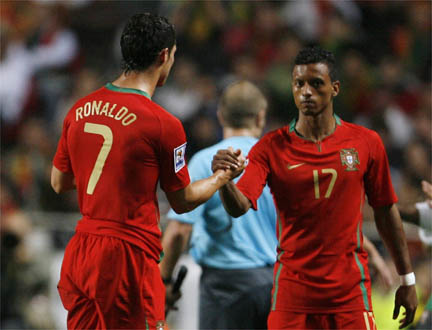 |
| Taking responsibility: Nani looks to finally replace Ronaldo |
But alas, after years of frustration it seems as if Nani is finally settling into the world's expectations. Last season was by far his best, scoring nine goals and assisting a league leading 18 goals and this season has been just as productive with 6 goals already in 17 appearances along with 8 assists. While the assists stats are impressive, what Nani is doing now, which is getting him close to replacing Ronaldo, is scoring more goals. Confidence and adaptability to league are the major reasons behind this reign of form.
Most of Nani's good form for United the previous season had come while playing as a right winger rather than his original left winger position. From that area he was able to use his trickery and speed to greater effect in order to find space to whip crosses in. Along with that ability, his strength with the left foot meant that he was able to double guess his marker and sometimes shift to his left boot if he was being marked down his right side. Thus, with the added potential of attacking the by-line and playing crosses across the face of the goal, Nani added the ability to move centrally and become more of a goal scoring threat, something which was ultimately what took Ronaldo from being a talented winger to one of the best players in the world.
 |
| Left: Nani vs QPR 11-12, Middle: Nani vs Stoke 11-12, Right: Ronaldo vs Chelsea 07-08 (c) Guardian Chalkboards |
Therefore, it can be seen that while Welbeck is assuming the role of Tevez this season, Nani is continuing on his progression to replace the role Ronaldo had at United at being not only a goal creator but a genuine goal scoring threat.
Rooney playing how Rooney knows best:
The third ingredient in United's 07-08 attacking formation was Wayne Rooney. Its difficult to really write about his role within the current formation since it is virtually the same as it was during that season with Tevez and Ronaldo. If there is one slight difference, it is that he has assumed greater responsibility towards not just goal scoring but also being more involved in the game as a whole. With no Scholes in the side, United's central midfield is much less capable of being a danger in possession and that has given Rooney a greater urge to come deep and try to spray passes in order to get the wingers involved further up the pitch rather than them coming deep in order to receive the ball.
Besides the 2009-10 season where he assumed a pure lead striker role either alongside Berbatov or as part of a 4-2-3-1, Rooney has been much more of a deep lying striker who has been given full freedom to come deep and be part of the build up of attacks. Of course with Ronaldo and Tevez alongside him during the 07-08 season, he was much less worried about the lack of goals that could come with him playing deeper, which was the case as well last season as first Berbatov and then Hernandez were employed as the front strikers while Nani gained goal scoring form playing down the right. The difference though between the two attacks was that the speed and attractiveness of attack was not as good as it was since Hernandez lacked the ability to pass and move effectively while Berbatov's sluggishness in possession generally slowed down the play.
 |
| Left: Rooney vs Fulham. Right: Welbeck vs Fulham 11-12 (c) Guardian Chalkboards |
Jones-Carrick provide fire and ice in midfield:
 |
| Jones provides the Fire in midfield. |
That ability has been shown time and time again during his last few matches as a central midfielder and all have been impressive. Apart from his fantastic goal winning header against Aston Villa, the young man was unlucky not to be on the scoresheet against QPR after hitting the post following another great run forward from deep. The ability and eagerness to go forward was not seen often from either Michael Carrick or Paul Scholes during the 07-08 season though Anderson showed potential in that respect during his few appearances that season.
One issue though that can come from a central midfielder going forward is the space left in behind and in the days of the 4-2-3-1, that space left behind can be dealt with in with deadly consequences. FC Basel's Xherdan Shaqiri took advantage of that space while playing against United's central midfield duo of Ryan Giggs and Phil Jones (mentioned here). While Jones is a natural defender, his regular runs forward make his role more of a box to box midfielder and therefore, as with many successful teams throughout the ages, with a box to box midfielder must come a covering more defensive midfielder to hold the space behind his midfield partner and infront of his central defence. This is where Michael Carrick comes in.
 |
| Carrick heat map vs Wolves (H) 11-12 (c) ESPN Soccernet |
The overall effect Carrick's role in midfield has to bring more balance and solidity giving Jones the freedom to roam forward without the doubt of not having a covering midfielder behind him. Though of course the defensive abilities of Jones should not be forgotten while his ability to attack surprises many. Therefore, the combination of Jones and Carrick is one of attacking ability while also providing defensive strength at the same time, either through the Jones and Carrick teaming up while United are not in possession or Carrick making sure there isn't space for the opposition to exploit down the middle on the counterattack.
Bright future in store:
While many will be quick to point out that the recent encouraging performances have come against three frankly weak Premier League signs, many should also remember that United were struggling to get past similar sides prior to the return of Welbeck into the starting line up. Therefore there has definitely been a positive effect from his return and with Welbeck still only 21, also Rooney and Nani still in their mid 20's, and with only six months of consistent first team football at United on his belt, there is plenty to be suggest that the performance against FC Basel on the 7th of December will remain the bottom for many years to come.

No comments:
Post a Comment