 |
| Hermann and Reus were key to gunning down their title rivals |
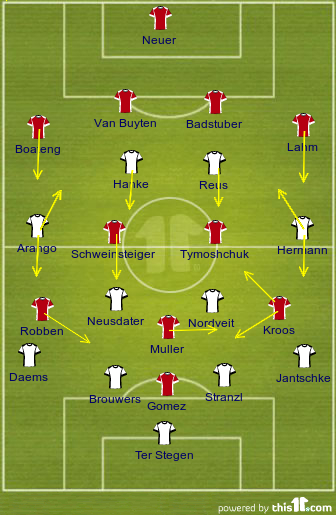
The starting line-ups:
There was little change from the usual in both line-ups. Monchengladbach returned for the second half of the season with only one injured starter, center back Dante, who was replaced by Roel Brouwers. Bayern Munich were without their star of the first of the season, Frank Ribery but were still able to recall Bastian Schweinsteiger into the starting line-up after three months out with injury following a broken collarbone sustained during Bayern Munich's Champions League clash against Napoli.
Neuer's error puts Bayern in painful spot:
It had to be. Bayern Munich's Manuel Neuer had a virtually spotless first half of the season for his new club, the only spot was an error in the first game of the season against his current opponents, one which the press was keen to point out prior to the fixture and no doubt would be on the German No.1's mind.
The match started off at an even pace, both sides looking rusty in possession due to the lack of match practice following a month long break during winter. The high pressure from both sides did not help the oppositions aim to hold possession like they usually do, Bayern Munich average just over 60% possession while Monchengladbach 54%. While Monchengladbach were entirely defensive for the 90 minutes in their first encounter of the season against Bayern Munich, it seemed as if they were willing to fully test the defensive might of their much more illustrious opponents. Then. It happened.
Manuel Neuer gathered a back pass from Holger Badstuber just inside his box and proccedded to bring the ball out in possession while under slight pressure from opposition striker, Mike Hanke. A fairly innocuous situation for the 'keeper who has been praised for his ability to distribute the ball. Main times this season Neuer has been able to cleanly pass the ball to a teammate and thus Neuer attempted the same only for the pass to present itself kindly to the last person in the Bundesliga he would've wanted the ball to fall to, none other than the best player of the first half of the season, Marco Reus. With an empty net and 35 yards from which to aim, there was only going to be one outcome and thus Monchengladbach had found themselves in treasure land. The Foals have never lost this season after taking the lead. The situation was complete the opposite for Bayern Munich, in the five prior matches they had conceded first, they had lost all but one them. In essence, the 1-0 scoreline played to the strengths of one and the weakness of the other.
Favre Moves to Plan B'us', Heynkes can't find the ticket:
It has been mentioned before about the two popular tactics Lucien Favre has favoured during this season for his side. Two tactics largely set for two different set of opponents. While Monchengladbach have held on average 54% possession, they have not been afraid to sacrifice a bit of their share in order to apply a stronger defensive tactic. We have seen examples of this throughout the season: In their 1-0 win over Bayern Munich at the Allianz Arena, Monchengladbach held only 39% of possession while despite winning emphatically 5-0 win over the offensively strong Werder Bremen they held only 50% of the possession.
It seemed fairly obvious that despite being only 11 minutes into the match, Favre was confident enough not only in the ability of his defence to prevent Bayern Munich from scoring twice but also his brilliant offensive unit of Reus, Hermann, Arango and Hanke to play through the cracks in Bayern's defence and maybe score one or two more. A look back at history shows a defining similar performance while Favre was in charge of Hertha Berlin who were making similarly emphatic waves in the Bundesliga during the 2008-09 season. Playing at home against Bayern Munich, the team from the capital city held only 38% possession but still went on to beat the Bavarian's 2-1 with two counter attack goals from Andrei Voronnin.
Bayern Munich had little answer to Monchengladbach's stern defence; they were facing the defence that had only conceded one more than they themselves had prior to the match. The creativity of Frank Ribery was clearly missing and while Toni Kroos was able to play some fantastic balls over and through the defence (some wrongly called back for offside), there was ultimately little penetration or width from either Kroos or his supporting left back, Phillpp Lahm. Kroos has never been a player with the pace or trickery to dribble past opponents, therefore he was never going to be comfortable trying to beat his marker, the defensively very solid Tony Jantsckhe, and attack the by-line. The same was largley true for Lahm who again preferred to play with his stronger boot and largely refrained from attacking the by-line. Therefore with the play of Kroos down the left only went in favour of Favre's tactics to narrow the play and concentrate his defenders on defending their box.
 |
| Left: Kroos vs Monchengladbach (A), Right: Ribery vs Hannover (A) (c) Bundesliga.de |
 |
| Robben vs Monchengladbach (A), (c) Bundesliga.de |
The Borussia Bus roars through Bayern's Flimsy Wall:
Monchengladbach's fabulous counter attacking ability had already been discussed in my previous article regarding the tactics of Favre's side, so it was no surprise to see Monchengladbach devastate Bayern Munich's defense. That being said, it could've been stated that, given the reputation they gave garnered throughout Favre's time, Monchengladbach were a bit disappointing in their passing before Hanke's wonderful through ball opened up space for Hermann to score past Neuer close to the first half break. Big match jitters or lack of match practice could've been mentioned as the reasons but the Foals gained confidence in the second half and continued to break apart the Bayern defence looking dangerous each time they received the ball.
It was a continuing of the policy held by Monchengladbach for much of the season; immediately attacking after winning possession. The attack was lead from the front by strikers Marco Reus and Mike Hanke who once again played pivotal roles in building up attacks from deep positions for their attacking wingers who were constantly picking up spaces left behind by attacking full backs. With an emphasis on the speed of attack, a mix of short passing and fantastic running ability off the ball ultimately put the Bayern defence to the sword, Monchengladbach only attempted 6% long passes while Bayern's average totaled over 10%, something that was again picked up on in the previous article.
 |
| Passing of Arango (18), Hermann (7), Reus (11) and Hanke (19) (c) Bundesliga.de |
With all the lavish praise that has been sent to Lucien Favre's side, it has to be said that they played no differently then they have throughout much of the season. The display of defensive solidarity mixed with a superbly efficient attack has been put out time and time again to go alongside times where they have bossed possession against some of the weaker sides. There has been much talk about whether The Foals are geniune title contenders and though the overall quality of their squad would not suggest it, we have seen worse sides come away with the title in previous seasons (though it can also be argued that the quality of the league as a whole was not as good as it is today). Non the less, to be a title contender, you have to be able to take points of your opponents and that is something Monchegladbach have shown the ability to perform. The win against Bayern no puts them joint top with Borussia Dortmund in the 'Top 6' table with 11 points and only one loss, to Schalke at the Veltins Arena.
Much of that ability to beat the top sides comes from Favre's policy of playing a largely counter attacking game against sides with great offenses, as mentioned before. A 'Plan B' that has been very successful, compared to their season average of 54%, Monchengladbach average only 46% possession against teams from the top 6. The 'Plan B', in essence, is what is currently missing from the Bayern Munich's side. That is not something new. For much of last season Bayern Munich lost similar matches to this in where they were allowed to keep majority of the possession against an extremely deep defence while the opposition were only keen on attacking occasionally on the counter. Heynkes' more disciplined tactical approach had looked to throw away with some of those problems, Bayern had gone over 11 matches without conceding while also managing to comfortably defeat one of the best exponents of the counter attack in Europe, Napoli, in the Champions League, but these issues have crept back recently during the losses to Dortmund and Monchegladbach once again.
Those issues though can be left for another time. For now, all we can do is sit back and wallow in the excellence of Borussia Monchengladbach's performance.

Interesting article and a great read. Thanks!
ReplyDeleteI'm not sure that I agree with your conclusion though.
Besides the different age structure the Bundesliga is set apart from the other leagues by it's high competitiveness (especially in the Top 4).
Maybe the Bundeliga's problem is that there is only one "big club". In Spain, England and Italy there are at least 3 teams that have been competing in the CL consistently over the years. This, rather than it's youthfulness, seems to be the reason for the Bundesliga's comparative lack in Cl prowess.
Establishing a team in Europe takes more than one season. Tottenham had a great run, but they failed to qualify again for the next season. Beeing a "big team" means doing both. If Dortmund manages to reach the Cl stage regularly, than the performances will improve.